
The 36 Decans in Egyptian & Hellenistic Astrological Practice: Traditions & Techniques
Decanic Holograms & Stellar Sphaera: Part Three of Three
By Cameron Cassidy
THE LAKE OF THE SKY: DEMOTIC AND DECANIC ASTROLOGY IN HELLENISTIC EGYPT
Nechepso and Petosiris have been invoked for millennia as the enigmatic figures who received, in a divine revelation, the greatest secrets of wisdom, composing the knowledge into tomes of texts kept in Egyptian temples. The knowledge covered astrology extensively, but also palmistry, alchemy, medicine, numerology, and magic (Laszlo, 2024: 4).
From an astrological perspective, Laszlo (2024) cites the surviving attributions to their texts regarding the following topics: eclipses, comets, fixed stars, structure and sizes of the planetary spheres, the Thema Mundi, the 36 Decans, the bright degrees, auspicious places (houses), the lot of Fortune, topics of life concerning birth, marriage, travel, children, injuries, ailments, the domicile masters of the birth, the length of life, times of life, crises, conception, rectification, inceptional/katarchic astrology, and decumbitures. This fundamental work underscored all of the surviving material from later authors of the Hellenistic tradition.
Who were they, and when were they alive? This question is guarded by the distant conjunctions of the heavenly spheres from long ago. Modern scholars place the dating of these writings around 150 BCE (Quack, 2018a: 113), yet Ryholt has proposed potential earlier dating to the 26th Dynasty, linking Nechepsos to King Necho the Wise or Necho II of the 7th century BCE, and Petosiris to the sage Petesis (Ryholt, 2011). Although there are strong literary, historical, and astronomical arguments for this hypothesis, we currently lack a clear textual link from these early dates. However, the duty of the priests was always to protect and hide this knowledge at all costs.
In searching for their origins, Pingree points to potential links from Mesopotamian omenology that were brought to the Hellenistic world by writings "under the name of Zoroaster, the school of Berossus and his followers, as well as the Egyptians behind the works of Hermes and Nechepso-Petosiris" (Quack, 2018a: 110). However, Quack refutes this, citing the remarkable similarity between Demotic and Greco-Roman astrological sources, as well as the much larger citation of Egyptian sources in the Hellenistic texts, as opposed to Chaldaen references (Quack, 2018a: 110-111). Nevertheless, with so many astral concepts from the Babylonians (Rochberg, 1988) and considering the findings of Bezold and Boll (1911), it is hard to rule out the possibility altogether.
Berossus was a Babylonian priest of Marduk who published a history in Greek of Mesopotamia around 290 BCE called the Babyloniaka (Verbrugghe & Wickersham, 2001: 13), akin to the Egyptiaka of Herodotus, being a crucial element of Hellenistic era transmission of Babylonian wisdom (Beaulieu, 2021). He also established an astrological school in Greece on the island of Kos, an essential vector for the influx of Babylonian knowledge to Greece (Verbrugghe & Wickersham, 2001: 14).
In the question of early Egyptian astrological texts, the most elusive text, Salmeschiniaka, arises in the foreground. This word has been cited by a tiny handful of ancient authors, with very little genuinely known about its contents. Scholars are perplexed about its etymological origin, having proposed translations such as: "Book of the Places of Birth," "Book of Images," "The Book of the Ursa Major," "Wandering of the Constellations," others refusing to translate it, or simply settling on a surety of the Egyptian or Babylonian origin of the name (Akridas, 2021: 13-14).
Akridas settled on a new proposal, rendering "The Measurement of the Image'' as its potential Greco-Babylonian origin. The present author is also inclined to note the simple and similar rendering of the early form for the word almanac, as referenced by Eusebius in responding to Porphyry, calling out the "almenichiaka" (Gundel, 1936: 342), perhaps highlighting the inclusion of vital tables or celestial positions, with the rules and techniques for applying them to genethlialogy.
The name and contents of the books are referenced only by Porphyry, Iamblichus, and Hephaistion of Thebes, including descriptions of "those stars which fill up the zodiac, and as many as rise near them: also the divisions into the Decani, and the horoscopes, and the so-called mighty rulers, the names of which are contained in the Salmeschiniaka, and their powers to heal diseases, and their risings and settings, and indications of future events" (Akridas, 2021: 12).
Suppose these texts truly conveyed the divine names of the Decans, the deities that ruled them, their healing powers, their eects on nativities, and the co-rising paranatellonta of the Decans. In that case, we can imagine the same doctrines assembled by later authors like Teukros (Decans, paranatellonta, rising eects), Maternus (Healing powers of Decans, bright
degrees), and Hephaistion (Divine names of Decanic powers, effects of rising Decans, topics counted from rising Decan, physical marks/signs, critical years/future prognostications) all transmit the key elements of these sacred texts. These later authors will again be brought up closely in Celestial Holograms.
Among the early texts, there is not much discussion of the Dodekatropos, or twelve-house system, at all, and reading through the extant topical fragments from Laszlo (2024), it is apparent they do not appear at all. All we see are delineations based on mutual aspects and rulerships among the seven spheres, without mention of any of the twelve places, save the mention of some "lots" of Fortune and Fate, recalling elements of Demotic horoscopes, which we will shortly explore.
We must consider that along the lines of the text revealed above, ancient Egyptian astrology was originally entirely Decanic and entirely based around the rising Decan at birth and its eects, as recounted in the Salmeschiniaka fragments, without the use of the Dodekatropos. Greenbaum & Ross note the original terminology of the Decans, as 36 'hour-regulators' or horonomoi, arose as the precursor to the 'hour-markers' or horoskopoi, with the occasional reference to the Decans as "36 bright horoscopes'' themselves, leading towards the evolution of the traditionally established ascendant of the Dodekatropos (Greenbaum & Ross, 2010).
We can assume the Hermes text authoring the Dodekatropos arose from a simplification of the counting of Decans around the horoscope to just the 12 signs and emerged after or alongside the Oktotopos, or eight-house system given in a text attributed to Asclepius. Fagan (1973: 161-170) cites the Oktotopos as an original Egyptian creation from Asklepius/Imhotep and writes that it is purely temporal, not spatial, nor associated with zodiacal signs. This teaching was likely passed to Nechepsos and Petosiris, perhaps related to the numerological "Circle of Petosiris" (Laszlo, 2024: 44-48). Thrasyllus is the first to cite the Hermes text or the Dodekatropos in general, writing from the first century CE (Brennan, 2017: 68-72).
Within the temples where these texts were practiced, Egyptian astrologers had an intense initiation into the Egyptian scribal priesthood, joining the 'House of Life,' learning the Book of Thoth, a sacred document exposing the mysteries of the hieroglyphic figures, the magical powers of the sounds and symbols of the Egyptian language, and their correspondence with other Earthly and Celestial energies (Jasnow & Zauzich, 2021).
Priests were generally organized in various ranks, assigned dierent tasks, and equipped with various specialties of knowledge (Quack, 2021). Quack also describes the fundamental Book of the Temple, describing it as, "an enormous manual of the ideal Egyptian temple, comprising a description of the architectural layout as well as enumerations of the duties of all priests and temple employees" (Quack, 2021: 76).
Astrologer-priests were uniquely tasked with tracking the Decans over the year and night to mark times for rituals, performing the ritual magic, leading festivals through the monthly lunar calendar, tracking omens and planetary motions, noting the hours of births, and performing various kinds of divination. When making horoscopic calculations, the priests were instructed to keep their methods and computations secret, hidden from those uninitiated people (Winkler, 2021: 104). Apparently, only the priests in the fourth and last stage of the initiation journey were instructed in the astral arts (Winkler, 2016: 270).
Several temple remains also shed light on the priesthood's practices and transmission of knowledge, mainly through the extant Zodiacs. The Zodiacs at the temples of Dendera and Esna are also highly significant to the Decanic transmissions. Dendera, Egypt's only circular zodiac diagram from this period, depicts the Egyptian Sphaera, or cultural sphere of constellations depicted in the starry heaven. The images themselves are the figures of Decans or groups of Decans, including a sheep, boat, and pair of turtles (Symons, 2015a: 103), yet also all the animals in the Dodekaoros, explained more thoroughly below in Celestial Holograms.
Esna's linear Zodiac is significant as it is the first visual depiction of the Decans directly as even 10-degree divisions of the 360-degree ecliptic dated to the middle of the first century BCE (Belmonte & Lull, 2023: 110). Both Dendera and Esna use the divine names from the Sety IB and Tanis lists, and Hephaistion uses virtually the exact sequences of Decans listed in Denderah (Neugebauer & Van Hoesen, 1960: 6).
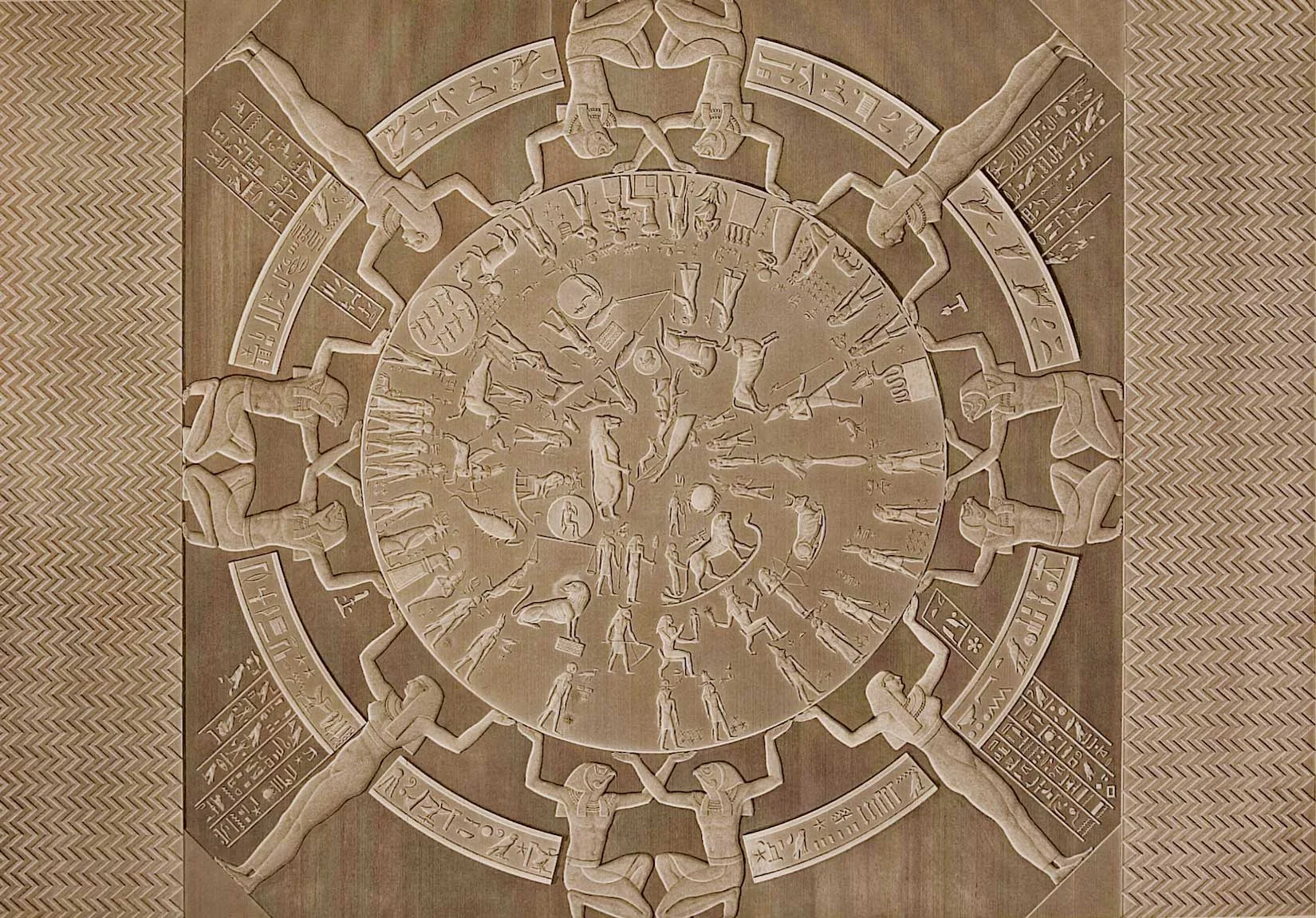
Reconstructed ceiling image of the upper chapel ceiling from the Temple of Hathor in Denderah.
Astrological texts written in the Ptolemaic period in the Demotic language fall into two categories: natal and world astrology. Much of the texts are composed entirely around the functioning of the Decans for both contexts. However, many texts mention the Zodiac as well (Winkler, 2021: 94). Some of the Decanologies of the Demotic priests, for example, noted the Decan of the Sun, Moon, and other planets in nativities, which are likely the antecedents to those texts carried forth by authors like Antiochus, Heliodorus, and especially Hephaistio (Quack, 2018a, 97-98).
For world astrology, they looked to eclipses and comets, as Nechepso was said to have discussed, as well as the heliacal rising of Sirius, and noted in which signs and Decans the planets were (Winkler, 2016: 246), which is a doctrine passed down by Hephaistion (Hephaistion, 1994: 37-63). Hughes notes (Hughes, 1951) a Demotic text where the acronychal rising of Sirius was also a time for prognostications. When the star makes its eastern rise after sunset, a phase indeed tracked by the Babylonians and the Egyptians, as Sirius enters its prime working phases at night and commands some rule on Earth, earning the inquiry of world divination.
In recent years, more research has been conducted on translating Demotic manuals, almanacs, and horoscopes from the first century BCE to the second and third centuries CE. The later Demotic manuals show an evolution inclusive of many doctrines referenced by Nechepso and Petosiris along with other material from early Hellenistic texts, namely the diurnal/nocturnal sects, benefics/malefics, the Heptazone order, the Zodiac, exaltations/depressions, the Egyptian Bounds, the 36 Decans, the Dodekatropos, and aspects, almost a full suite of celestial tools, written in Demotic and Greek during the Roman period in Tebtunis (Winkler, 2016).
In his analysis of certain Demotic horoscopes, Neugebauer discovered five additional points that astrologer-priests often included in their horoscopic calculations (Neugebauer, 1943: 116-119). The five points include the three "swšp" and the two "twr." The three swšp were rotated axes that intersected the 6th, 9th, and 12th places, just like the ascendant, midheaven, and descendant only rotated 30 degrees. Then there were also the two twr, which run parallel to the swšp axis, landing on points in the 11th house and descending angle.
These unknown and undescribed horoscope factors are highly reminiscent of the Decanic techniques from the Salmeschiniaka referenced by Hephaistio (Schmidt, 1998: 26). These points mirror important Decans "that the ancient Egyptians used in every nativity," plus the consideration of the 34th Decan residing in the 12th house, 30 degrees above the ascendant. This is where the Lot of Daimon is in the Thema Mundi, in the second Decan of Gemini, where the star Sirius projects onto the ecliptic in the fixed sidereal Zodiac. This Decan was used in connection with the amuletic, iatromathematical powers of the Decans in making healing talismans for protection (George, 2021 & Feliciano, 2015).
A diagram of these additional Egyptian horoscope factors lies below.
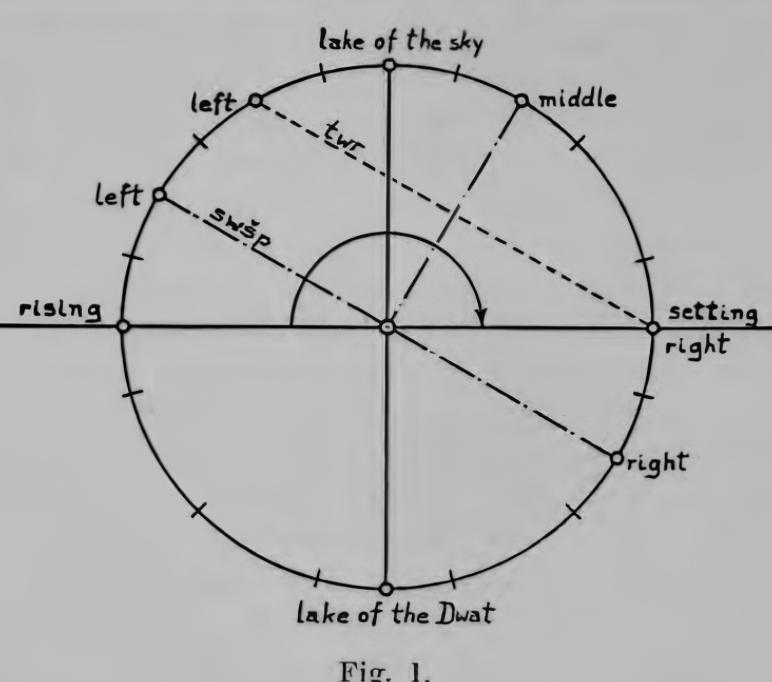
Figure 1 from Neugebauer on Demotic Horoscopes
From the Salmeschiniaka, we can perhaps assume these twr and swšp assist astrologers in identifying the most critical Decans, which reveal essential life factors, such as marriage, illness, children, and the identification of a Decanic spirit and remedy against the illnesses to which the native is inclined (George, 2021).
CELESTIAL HOLOGRAMS, SPHERES, AND DECANS IN EARLY HELLENISTIC ASTROLOGY
In the Ptolemaic period, we know the Egyptians were having a renaissance of Decanic astrology again, just like in the New Kingdom. Meanwhile, Babylonian and Mesopotamian wisdom was flooding itself west to the Mediterranean in Greece and Rome. According to scholars, the Greeks were producing forgeries of Mesopotamian and Egyptian wisdom at this time (Momigliano, 1975: 171). Others have already gone to give extensive detail in the ways Greek astrological authors like Diodorus, Ptolemy, Valens, and Theon of Alexandria- all rewrote earlier cuneiform astronomical and astrological texts (Bezold & Boll, 1911: 3-4).
Even the myths of the Greek divinities, the books of the Bible, the stories of the Arabian Nights, the Iliad, and the Odyssey of Homer- all share immediate connections that point to early Mesopotamian literature, which directly inspired these outstanding works of world literature (Dalley, 2008: xviii-xix). On the Egyptian side, this was mainly because the Hermetic wisdom of philosophy and astrology was given only in oral teachings and forbidden from ever being written down, that it has been more challenging to prove the Egyptian inspiration behind all of Greek philosophy (James, 2023).
The crucial turning point in the thread of these discoveries lies in the texts of Teukros the Babylonian, a mysterious figure and, perhaps, the most crucial transmitter of Egyptian sky lore directly into Hellenistic astrology through the Dodekaoros. His texts contained delineations for the 36 Decans, the co-rising images from both the Sphaera Barbarica and the Sphaera Graecanica (Boll, 1903).
Teukros also authored a text delineating the seven planets within each Decan, which is now lost. Some of his texts were transmitted through authors like Antiochus, Porphyrios, Rhetorius, Varaha Mihira, Sphujidhvaja (Yavanajātaka), Abu Ma'shar (Panaino, 2002), and even the Byzantine verse poet Johannes Kamateros (Kamateros, 1908), who eventually transmitted his doctrine on the Sphaera Barbarica, and specifically, the Dodekaoros (Boll, 1903: 21-30). This Dodekaoros would later be depicted in zodiacal art, such as the Daressy Zodiac, Ponza Zodiac, or the Tabula Bianchini pinax (Thompson).
In light of the Teukros texts on the Decanic segments of the sky, much confusion arose to scholars when considering why constellations like Ophiuchus are listed in the middle Decan of Gemini. Mosenkis (2015a) wisely points out that these inclusions are both co-rising and co-setting images, bringing us back to the importance of the opposite images, which always enter phases together, as the original astrolabe first described it. The Dodekaoros follows a similar scheme, as we will see below.
The Sphaera Barbarica is essentially the amalgam of 'barbarous' or foreign constellations to the Greeks, including both Mesoptomian and Egyptian native imagery, and its first reference in literature comes from the 1st century BCE, from Nigidius Figulus (Boll, 1903: 349-363). Prior to this time, the wisdom of these images was simply the common knowledge of the initiated Mesopotamian and Egyptian priest-astrologers.
The Greek Sphaera assimilated itself slowly over centuries, birthed from the initial and now-lost works of Eudoxus (4th century BCE), the Phenomena ("Appearances") and Enoptron ("Mirror"), both described in extensive detail for the first time the wisdom of the Sphaera Barbarica in Greek. One century later, Aratus took the works of Eudoxus, put them in verse, and helped standardize the newly forming Greek Sphaera in his version of the Phenomena (Gee, 2013).
In his teachings on Hellenistic Astrology, Robert Schmidt proposed that the Eudoxus was a key element, if not the sole impetus behind the creation and reproduction of earlier astrological doctrines into a coherent Hellenized system around the 4th century BCE (Schmidt, 2015). Eudoxus is a puzzling figure for historians, but he may have roots in Egypt since bilingual astrological texts in Demotic and Greek named after his work still survive in the papyrus Paris I, which contains the Ars Eudoxi from the early second century BCE (Quack 2018a: 77).
Following Eudoxus and Aratus, Hipparchus wrote his commentary on the Phenomena of Eudoxus and Aratus (Gysembergh, 2018) and, finally, with Ptolemy, the Sphaera Graecanica armed itself into the Hellenic astral coagulum, composed of 48 images: 12 being zodiacal and 36 extra-zodiacal. The images put into story, myth, and poetry by Aratus, Eratosthenes, and Hyginus crystallized the starry firmament Westward into the minds and memories of the Greeks (Hard, 2015). However, they lacked explicit citation to the entire system's original Mesopotamian and Egyptian bases, casting a false light on Greek and Hellenistic 'innovations.'
Valens, active circa 2nd century CE, used similar paranatellonta definitions in his descriptions of the twelve zodiacal signs, as well as Decanic meteorological commentary (ed. Cumont, CCAG IV, 180), as was the standard of earlier Egyptian tradition (Lehoux, 2007: 123-126). Valens cites the Sphaerica, for instance, in Aries, saying, "The constellations that rise at the same time as Aries are (in the North) the first part of Perseus, the rear and the left parts of Auriga, and (in the South) the fin and tail of Cetus. <When Aries is rising,> the feet and Bootes (in the North) and the hind parts of Lupus (in the South) are setting." (Valens, 2022: 7).
The excerpt above emphasizes the key natures of the stars interacting on either side of the horizon, which have an intrinsic connection to and eect on the zodiacal segments of the signs in question. Valens describes the remaining signs similarly, noting the co-rising or co-setting images of the zodiacal signs on both the northern and southern sides of the horizon- a classical perspective rooted right back in the astrolabe's original 72-fold configuration.
However, there is good reason to assume the selection of 36 extra-zodiacal images with 12 zodiacal ones. Despite modern scholars' challenges in identifying and classifying many of the original Decanal stars, we can be sure these 36 images are the 'children' or perhaps 'cousins' of the 36 Decanal images of the Egyptians and Mesopotamians.
A specific piece of this Babylonian-Egyptian "sphaera" has been isolated from the whole and referred to specifically as the "dodeka[h]oros" (Bellizia, 2010: 6). The Egyptian images and associated deities depicted in the Dodekaoros correspond to the signs as follows, assembled by Bellizia, (consult her excellent paper for more detail on the Egyptian origins and relevance of these animals, in 2010):
Aries: Cat (Bastet)
Taurus: Dog or Jackal (Anubis)
Gemini: Snake (Apophis or Agathodaimon)
Cancer: Scarab (Kephera)
Leo: Donkey (Seth)
Virgo: Lion (Atum)
Libra: Goat (Ba-Neb-Djedet)
Scorpio: Bull (Apis)
Sagittarius: Hawk (Ibis)
Capricorn: Monkey or Ape (Thoth)
Aquarius: Ibis (Thoth)
Pisces: Crocodile (Sobek)
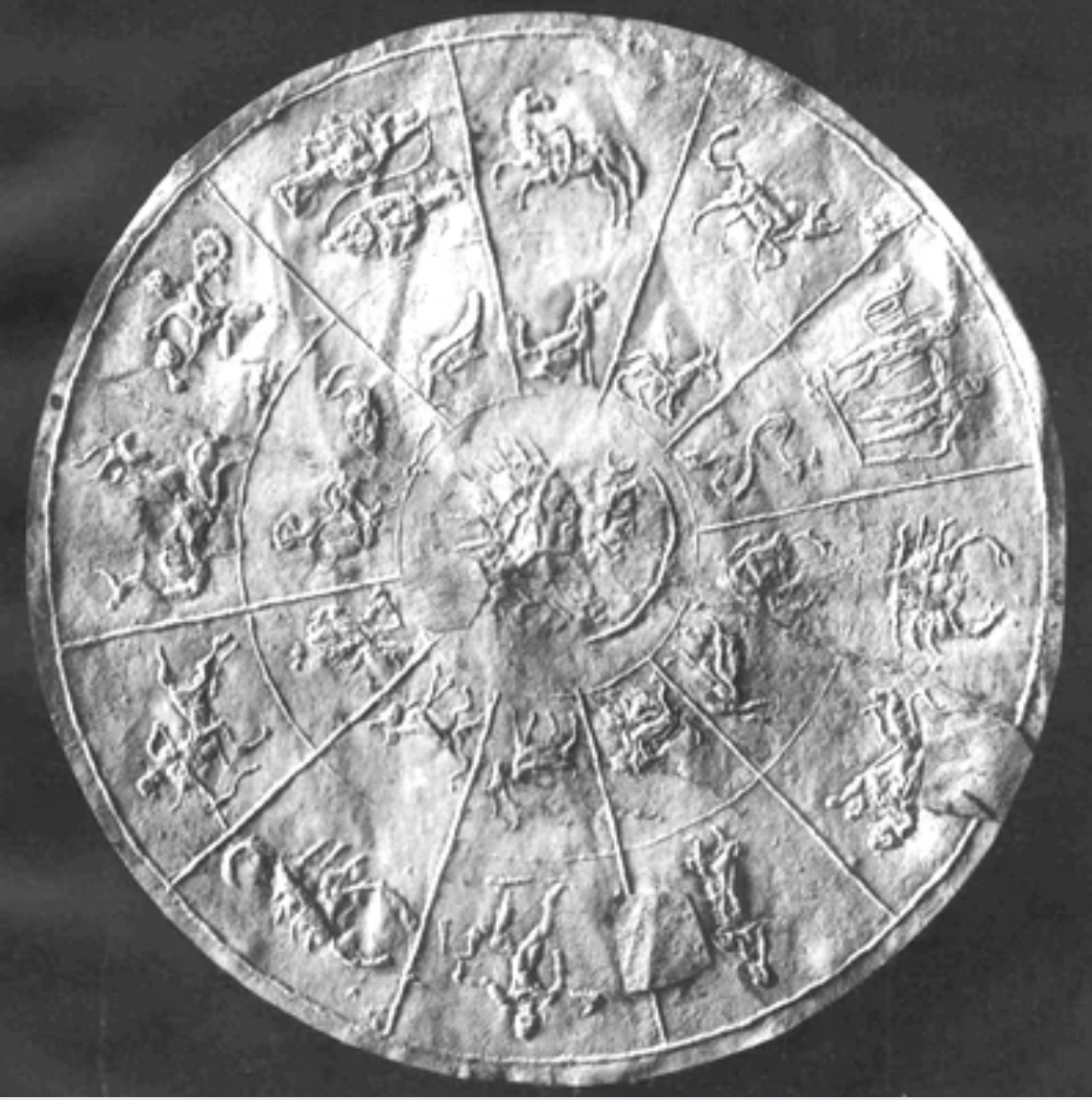
Daressy Zodiac
from Roman Egypt, depicting the Dodekaoros animals underneath their zodiacal counterparts.
Mosenkis (2015a) also described the oppositional affect of the list of the Dodekaoros, giving light to the stark inclusion of extra-zodiacal constellations in the Sphaera Graecanica, which appear in the classical listing of Teukros's Barbarous Sphaera, as well as in later zodiacs and boards:
"So, the main principle of nomination of the beast in the Dodekaoros is astrological aspect of opposition: rising Lupus-setting Taurus; rising Serpens-Setting Gemini; rising Capra-setting Auriga; rising Taurus-setting Scorpius; rising Gemini-setting Capricornus; rising Aquarius-setting Corvus. The second principle is paranatellonta: Lepus (Scarabaeus) rises with Cancer; Aselli (Donkey) rises before Leo; Aquila (Falcon) rises with Sagittarius; Cetus (Crocodile) rises with Pisces." (Mosenkis, 2015a).
The Dodekaoros as a whole appears to be an ascensionally timed set of twelve images, likely along the celestial equator, which each rise in two hours, giving rise to its name, which means "[circle of] twelve hours" (Boll, 1903: 309). This name also underscores the original Babylonian hour, which was double-hour, convenient for their sexagesimal system.
The matter of measuring the times of ascensions of the stars goes back to Mesopotamia (Steele, 2017) and then began to centralize itself to the division of the Zodiac with the lost but fundamental work of 2nd century BCE Alexandrian astronomer Hypsicles, called Anaphorikos (lit. "Ascensions," or "On Rising Times") (Evans, 1998: 90). It is thought to be the most ancient text written in Greek to reference the Babylonian division of the Zodiac (Montelle, 2016: 287-315). Ptolemy, who came along a few centuries later, made an eort to specifically discuss the ascensional times of the 36 Decans across the various climes or latitudes, assisting astrologers of the time and also putting Egyptian practices into an unprecedented mathematical clarity (Ptolemy, 1952: 52-55).
In light of Ptolemy and the Decans, in the Tetrabiblos, he even lists the geographical correspondences to each of the Decans (Ptolemy, 2002: 43-52). We can surmise, especially given the fragment from Rhetorius on eclipse prediction, which states that the Decan and Face lord of the eclipse must be observed as one of the first rules (Rhetorius, 2009: 207). This technique of combining eclipse prediction and Decans had been long practiced in Egypt, especially in light of the findings from the recently excavated Naos from Saft El-Henna, which delineates the mundane eects of each of the 36 Decans (von Bomhard, 2008), and considering the subsequent solar or lunar eclipses falling about one Decan backward every season. However, it all originated even earlier in Mesopotamia, where the 36 images had geographical correspondences, and the three paths and three watches were consulted in every eclipse to determine which image and region of the 36 stars would be affected, as the LBAT 1499 tablet or 'Astrolabe S' describes (Kolev, 2013: 118-119), not too dissimilarly from Ptolemy's technique.
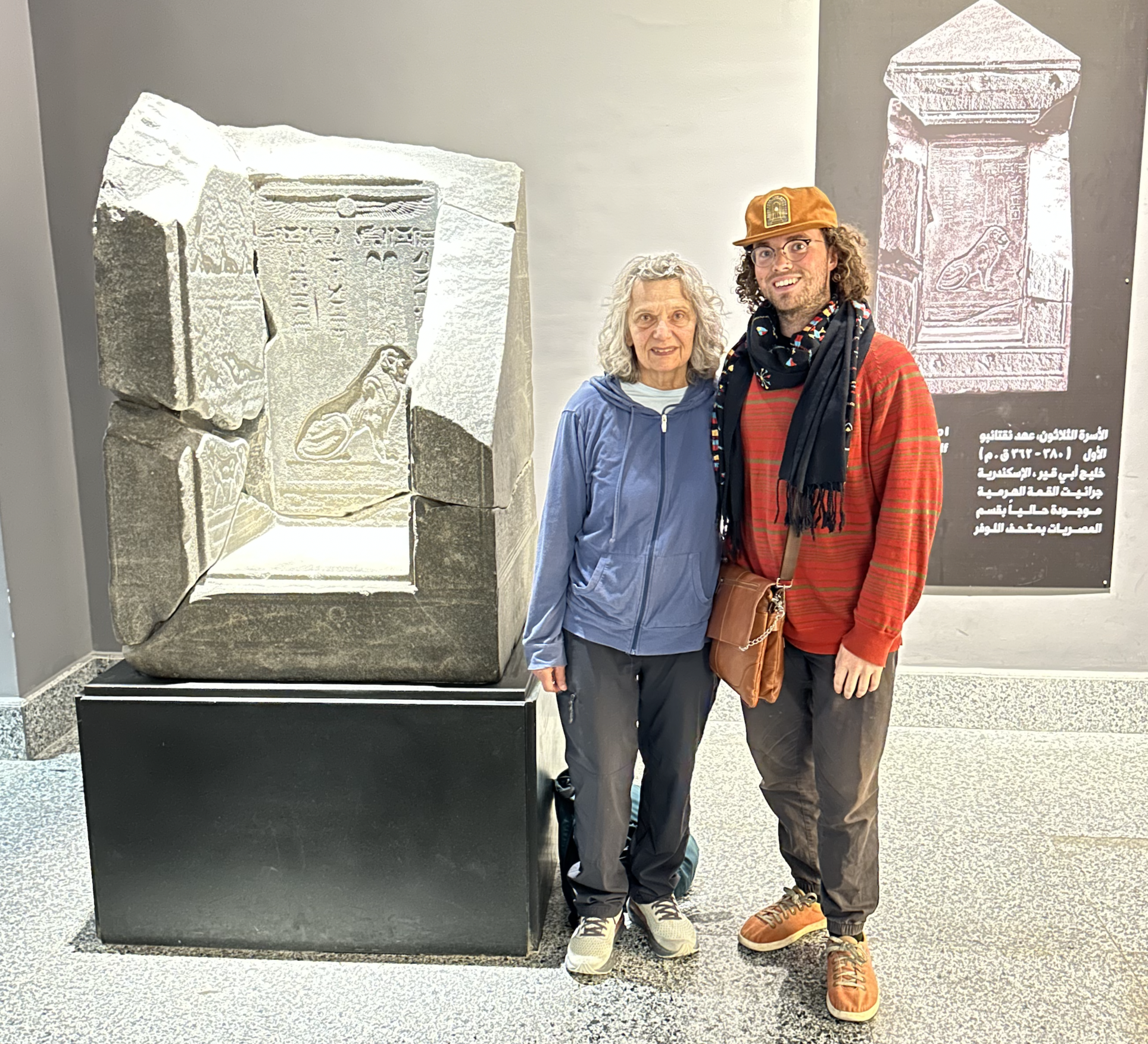
Me and Demetra George with the Naos of the Decades in the Greco-Roman museum in Alexandria, Egypt.
Without mentioning the rich metaphysical teachings of the philosophical Hermetica, here are the principal Hellenistic authors who transport teachings on the Decans in the general corpus of the practical Hermetica:
Teukros, the likely originator of the Decanic Heptazone rulership scheme, delineates each rising Decan, each planet in each Decan, and the co-rising stars of each Decan in the Greek and Barbarous spheres (Boll, 1903 & Rhetorius, 2009).
Manilius describes the Sphaera Graecanica in its entirety, giving delineations for the fixed stars and paranatellonta, along with the 36 Decans, in an idiosyncratic rulership scheme (Manilius, 1977).
Ptolemy describes the geographical relations to the 36 Decans in his Tetrabiblos (Ptolemy, 2002), gives their ascensional times plus 32 unique paranatellonta or co-angular configurations and refers to them as 'aspects' between planets and fixed stars in his Almagest (Ptolemy, 1952), and writes in his 95th aphorism that the co-rising images of the Zodiac indicate a man's professional inclinations (Ptolemy, 2002).
Valens does not reference the Decans, a bizarre fact considering all of his Egyptian sources and references. However, he references them briefly in a later Byzantine manuscript when discussing the signs and meteorological eects of the sign regions, specifically the Decans (Gundel, 1936: 402).
Antiochus delineates a sentence or so for each Decan when rising and becomes the archetype copied by Rhetorius (Antiochus, 1993).
Porphyrius describes how to delineate a planet in a Decan, based on the planetary ruler of the 'face' or Decan (Porphyrios, 2010).
Maternus says a planet in its own Decan is as powerful as a planet in its own sign and later describes the bright degrees and leitourgoi of the Decans, a doctrine from King Nechepsos, explaining how the bright fixed stars of the Decans aect nativities (Firmicus Maternus, 2023: 310-316).
Paulus describes the Heptazone system of planetary rulership over the 36 Decans and writes that a planet in its own Decan is as powerful as being in its own sign (Paulus, 2012).
Hephaistion delineates extensively each rising Decan, as well as giving the life eects (based on which planets rule those central topics from the Decans listed in the Salmeschiniaka), physical marks or signs on the body, and critical years (Hephaistion, 1994).
Heliodorus describes the unique eects of the 36 rising Decans (Gundel, 1936: 418-420)
Rhetorius describes how each of the seven planets aects the Decans that it rules; he also copied Antiochus's short delineations for each Decan and lastly transmitted an earlier doctrine of Decans producing scandalous, hedonistic or lascivious behavior, focusing mainly on Venus, but also listing the eects of the other six planets in Decans which make lascivious combinations (Rhetorius, 2009).
Theophilus delineates the eects of Solar and Lunar eclipses in each of the 36 Decans, which likely transmitted the base for a similar text composed by William Lily (Gundel, 1936: 403-405).
Kamateros delineates the eect of each rising Decan and gives the paranatellonta according to Teukros (Kamateros, 1908).
Several Greek papyri from the Hellenistic and later periods also preserve older elements of the Egyptian Decanic tradition. We can infer they were copies of lost texts or innovations within the still very early Decanic practices. There is a later text, reminiscent of the Salmeschiniaka excerpt from Hephaistion, which delineates all 36 Decans as counted from the ascendant, not just the seven preserved from the famous excerpt (Gundel, 1936: 409-411). Another fragment of the Salmeschiniaka from Oxyrhynchus describes the magical images, powers, and birth eects of the 72 Pentad-gods, 2 ruling each Decan for 5 degrees each (Gundel, 1936: 413-414), possibly related to the Gnostic traditions of astrological medicine involving 72 bodily melothesia correspondences, one per pentad (Adamson, 2013). We also find a text from Pseudo-Manetho delineating the position of the Lunar nodes through the Decans in nativities, following their backward motion, from the third Decan of Aries to the first of Taurus (Gundel, 1936: 415-416). Along with some Decanic numerological oracle books (Gundel, 1936: 405-408), their power appeared universally through the literature, always reflecting the sacred 36 powers created and organized by Marduk.
THE MOTHER OF ALL IMAGES
All systems replicate, get passed on, change somewhat, and then rediscover their roots to reground their evolution. It is a natural cycle of creation that, like a hologram, repeats throughout the world and, as shown throughout the evolution of astrological images and calculations. May we now recover the celestial hologram and embrace the three-dimensional images, this light is currently revealing. Even among the fragments of the past, the parts contain the knowledge of the whole. In deep analysis, we see the original system given by the creator tracing its way from before the flood to the flourishing astrology in the Hellenistic and later Roman periods. From there, the wisdom went back through Arabia to India and beyond. It sits in this journal now and, hopefully, in your mind.
BIBLIOGRAPHY
Adamson, G. (2013). Astrological Medicine in Gnostic Traditions. Practicing Gnosis, pp. 333–358.
Akridas, A.-G. (2021). Σαλμεσχ(ο)ινιακά: Measurement standards of astrotheology? Zeitschrift für Ägyptische Sprache und Altertumskunde 148, pp. 12–17.
Antiochus of Athens. (1993). The Thesaurus (Schmidt, R., Trans.). The Golden Hind Press. Bellizia, L. (2010). The Paranatellonta in Ancient Greek Astrological Literature.
Belmonte, J. (2003). Some open questions on the Egyptian calendar: An astronomer's view. Papers on Ancient Egypt (TdE), 2, 7-56.
Belmonte, J., & Lull, J. (2023). Astronomy of Ancient Egypt: A Cultural Perspective. Springer. Boll, F. (1903). Sphaera. Neue Griechische Texte und Untersuchungen zur Geschichte Der
Sternbilder. Von Franz Boll. B.G. Teubner, Leipzig.
Beaulieu, P.-A. (2021). Berossus and the Creation Story. Journal of Ancient Near Eastern History
2021; 8(1-2): 147-170, De Gruyter.
Bezold, C. & Boll, F. (1911). Reflexe Astrologische Keilinschriften bei Griechischen Schriftstellern. Heidelberg.
Brennan, C. (2017). Hellenistic Astrology: The Study of Fate and Fortune. Amor Fati Press.
Cumont, F. & Boll, F. & al. (1898-1936). Catalogus Codicorum Astrologorum Graecorum, Volumes I-XII.
Dalley, S. (2008). Myths from Mesopotamia: Creation, the Flood, Gilgamesh, and others. Oxford World Classics.
Deitrich, M. & Loretz, O. & Sanmartin, J. (2013). Keilalphabetische Texte aus Ugarit. The Cuneiform Alphabetic Texts from Ugarit, Ras Ibn Hani and Other Places. Münster.
Dieleman, J. (2003). Claiming the Stars: Egyptian Priests Facing the Sky. Aegyptiaca Helvetica, 17, 277-289.
Evans, J. (1998). The History and Practice of Ancient Astronomy. Oxford University Press. Fagan, C. (1973). Astrological Origins. Llewellyn.
Fagan, C. & Firebrace, B. R. C. (1971). Primer of Sidereal Astrology. American Federation of Astrologers, Inc.
Feliciano, J. P. (2015). The Sacred Book of Hermes to Asclepius. https://www.academia.edu/11429925/The_Sacred_book_of_Hermes_to_Asclepius. Accessed 21 Jan 2024.
Firmicus Maternus. (2023). Mathesis (Dykes, B., Trans.). Cazimi Press.
Gee, Emma. (2013). Aratus and the Astronomical Tradition. Oxford University Press.
George, D. (2021). Egyptian Decans: Star Gods of Time.
Gray, J. M. K. & Steele, J. M. (2007). A Study of Babylonian Observations Involving the Zodiac. Journal for the History of Astronomy, xxxviii.
Gundel, W. (1936). Dekane und Dekansternbilder: Ein Beitrag zur Geschichte der Sternbilder der Kulturvölker. Teubner, Leipzig.
Gysembergh, V. (2018). Hipparchus and the "Ancients" Nechepsos-Petosiris? JAC 33.2, pp. 165-179.
Hard, R. (2015). Eratosthenes and Hyginus: Constellation Myths, with Aratus's Phenomena. Oxford University Press.
Hephaistion of Thebes. (1994). Apotelesmatics Book I (Schmidt, R. Trans.). The Golden Hind Press.
Hephaistion of Thebes. (1998). Apotelesmatics Book II (Schmidt, R. Trans.). The Golden Hind Press.
Hollywood, L. & Steele, J. M. (2004). Acronychal Risings in Babylonian Astronomy. Centaurus 46, 145-162.
Hughes, G. R. (1951). A Demotic Astrological Text. Journal of Near Eastern Studies, Oct. 1951, Vol. 10, No. 4, pp. 256-264. University of Chicago Press.
Hunger, H. & Steele, J. (2019). The Babylonian Astronomical Compendium MUL.APIN. Routledge. In: The Sumerian King List: Translation. The Electronic Text Corpus of Sumerian Literature.
University of Oxford. https://etcsl.orinst.ox.ac.uk/section2/tr211.htm. Accessed 22 Mar 2024. James, G. J. M. (2023). Stolen Legacy: The Egyptian Origins of Western Philosophy. General Press.
Jasnow, R. & Zauzich, K.-T. (2021). Conversations in the House of Life: A New Translations of the Ancient Egyptian Book of Thoth. Harrassowitz Verlag.
Jones, A. & Steele, J. M. (2011). A New Discovery of a Component of Greek Astrology in Babylonian Tablets: The "Terms". ISAW Papers I.
Kamateros, Johannes. (1908) Eisagōgē Astronomias: ein Kompendium griechischer Astronomie und Astrologie, Meteorologie und Ethnographie in politischen Versen (Weigl, L. Trans.). Teubner, Leipzig und Berlin.
Kolev, R. (2013). The Babylonian Astrolabe: Calendar Of Creation. The Neo-Assyrian Text Corpus Project, Helsinki.
Laszlo, L. (2024). The Fragments of Nechepso and Petosiris. The HOROI Porject.
Lambert, W. G. (1967). Enmeduranki and Related Matters. Journal of Cuneiform Studies 21, 126-138. American Schools of Oriental Research, New Haven, CT.
Lehoux, D. (2007). Astronomy, Weather and Calendars in the Ancient World: Parapegmata and Related Texts in Classical and Near Eastern Societies. Cambridge University Press, Cambridge.
Leitz, C. (1995). Altägyptische Sternuhren.
Marcus Manilius. (1977). Astronomica (Goold, G.P., Trans.). Harvard University Press, Cambridge. Momigliano, A. (1975). Alien wisdom: The limits of Hellenization. Cambridge University Press.
Montelle, C. (2016), "The Anaphoricus of Hypsicles of Alexandria", in Steele, John M., The Circulation of Astronomical Knowledge in the Ancient World, Time, Astronomy, and Calendars: Texts and Studies, 6, Leiden: Brill.
Mosenkis, I. (2015a). Dodekaoros: Not Oriental but oppositional constellations and Paranatellonta. In: Academia.edu. https://www.academia.edu/11705701/Dodekaoros_not_Oriental_but_oppositional_constellatio ns_and_paranatellonta. Accessed 23 Apr 2024.
Mosenkis, I. (2015b). The sphaera barbarica: Oriental non-ptolemaic or native Greek constellations ? In: Academia.edu. https://www.academia.edu/11705682/The_Sphaera_Barbarica_Oriental_non_Ptolemaic_or_na tive_Greek_constellations_. Accessed 23 Apr 2024.
Neugebauer, O. (1943). Demotic Horoscopes. Journal of the American Oriental Society, Apr. - Jun. 1943, Vol. 63, No. 2, pp. 115-127.
Neugebauer, O. & Van Hoesen, H. B. (1959) Greek Horoscopes. American Philosophical Society, Philadelphia.
Neugebauer, O. & Parker, R.A. (1960). Egyptian Astronomical Texts. Published for Brown University Pres, by L. Humphries, Providence
Orlov, A. (2006). «the learned savant who guards the secrets of the great gods»: Evolution of the roles and titles of the Seventh antediluvian hero in Mesopotamian and Enochic traditions. Scrinium 2:165–213.
Panaino, A. (2002). "New Perspectives for an Intercultural Approach to the Sciences of Antiquity between East and West. Some Reflections on the Cultural Meaning of the MELAMMU Project." In: A. Panaino and G.
Parker, R. A. (1974). Ancient Egyptian Astronomy. Philosophical Transactions of the Royal Society of London. Series A, Mathematical and Physical Sciences, May 2, 1974, Vol. 276, No. 1257, The Place of Astronomy in the Ancient World, pp. 51-65.
Paulus of Alexandria. (2012). Introduction to Astrology (Holden, J. H., Trans.). American Federation of Astrologers.
Pettinato (eds.) Ideologies as Intercultural Phenomena. Melammu Symposia 3. Milan: Università di Bologna & IsIAO 2002, 1-12.
Plato. (1925). Plato in Twelve Volumes, Vol. 9 (Lamb, W. R. M., Trans.). Cambridge, MA, Harvard University Press; London, William Heinemann Ltd.
Porphyrios of Tyre. (2010). Introduction to the Tetrabiblos (Holden, J. H., Trans.). American Federation of Astrologers.
Ptolemy, Claudius. (1952). The Almagest (Taliaferro, R. C., Trans.). The Great Books of the Western World, The University of Chicago.
Ptolemy, Claudius. (2002). Tetrabiblos. (Ashmand, J. M. Trans.). Astrology Classics, a division of The Astrology Center of America.
Quack, J. F. (1999). Frühe Ägyptische Vorläufer der Paranatellonta? Sudhos Archiv.
Quack, J. F. (2016). On the Concomitancy of the Seemingly Incommensurable, or Why Egyptian Astral Tradition Needs to be Analyzed within Its Cultural Context. In J.M. Steele (Ed.), The Circulation of Astronomical Knowledge in the Ancient World, pp. 230-244. Brill.
Quack, J. F. (2018a). Egypt as an astronomical-astrological centre between Mesopotamia, Greece and India. In D. Brown (Ed.), The interactions of ancient Astral science (pp. 69-123). Hempen.
Quack, J. F. (2018b). Astronomy in Ancient Egypt. in P.T. Keyser & J. Scarborough (Eds.) The Oxford handbook of science and medicine in the classical world (pp. 61-70). Oxford University Press.
Quack, J. F. (2021). Priestly Scholars in Late Egypt: The Theoretical Side. Journal of Ancient Near History 2021; 8(1-2): pp. 73-90.
Rhetorius of Egypt (2009). Rhetorius the Egyptian: Astrological compendium (Holden, J. H., Trans.).Amer. Federation of Astrology, Tempe, AZ.
Rochberg, F. (1988). Elements of the Babylonian Contribution to Hellenistic Astrology. Journal of the American Oriental Society Jan. - Mar. 1988, Vol. 108, pp. 51-62.
Rochberg, F. (2010). Babylonian Astral Science in the Hellenistic World: Reception and Transmission. Center for Advanced Studies, Nummer 4 / 2010, LMU.
Ryholt, K. (2011). New Light on the Legendary King Nechepsos of Egypt. The Journal of Egyptian Archeology, vol. 97, pp. 61-72.
Schmidt, R. (2015). The Basic Course, part 2: The Eudoxus Files. Robert Schmidt Astrology: Archived Works of Robert H. Schmidt.
Spalinger, A. J. (1995). Month Representations. Chronique d'Egypte 70, 110-122.
Steele, J. M. (2017). Rising Time Schemes in Babylonian Astronomy. Springer International Publishing, Cham
Symons, S. (2015a). Contexts and elements of Decanal Star lists in Ancient Egypt. Traditions of Written Knowledge in Ancient Egypt and Mesopotamia 91–122. doi: 10.2307/j.ctv1t4m1wb.7
Symons, S. & Tasker, E. (2015b). Stars of the Dead. Scientific American 313:70–75. doi: 10.1038/scientificamerican1015-70
Thompson, G. D. Sphaera Barbarica and Sphaera Graecanica, online at: http://members.westnet.com.au/gary-david-thompson/page11-14.html
Verbrugghe, G. P. & Wickersham, J. M. (2001). Berossus and Manetho: introduced and translated, Native Traditions in Ancient Mesopotamia and Egypt. Michigan.
Vettius Valens. (2022). The Anthologies (Riley, M., Trans.). Amor Fati.
Von Bomhard, A.-S. (2008). The Naos of the Decades. From the observation of the sky to
mythology and astrology. Oxford Centre for Marine Archeology.
von Lieven, A. (2007). Grundriss Des Laufes Der Sterne. Das sogenannte Nutbuch, vol 8, The
Carlsberg Papyri. Museum Tusculanum Press, Copenhagen.
von Lieven, A. (2010). Translating the Fundamentals of the Course of the Stars. Imhausen, A. & Pommerening, T. (Eds.) Writings of Early Scholars in the Ancient Near East, Egypt, Rome, and Greece: Translating Ancient Scientific Texts (Beitrage zur Altertumskunde. Berlin 286). De Gruyter, Berlin/New York, pp. 140-150
Winkler, A. (2016). Some Astrologers and Their Handbooks in Demotic Egyptian. Steele, J. M. (Ed.) The Circulation of Astronomical Knowledge in the Ancient World, Brill.
Winkler, A. (2021). Stellar Scientists: The Egyptian Temple Astrologers. Journal of Ancient Near History 2021; 8(1-2): pp. 91-145. De Gruyter.