
Coffin Clocks: The Ancient Egyptian Origins of the 36 Decans
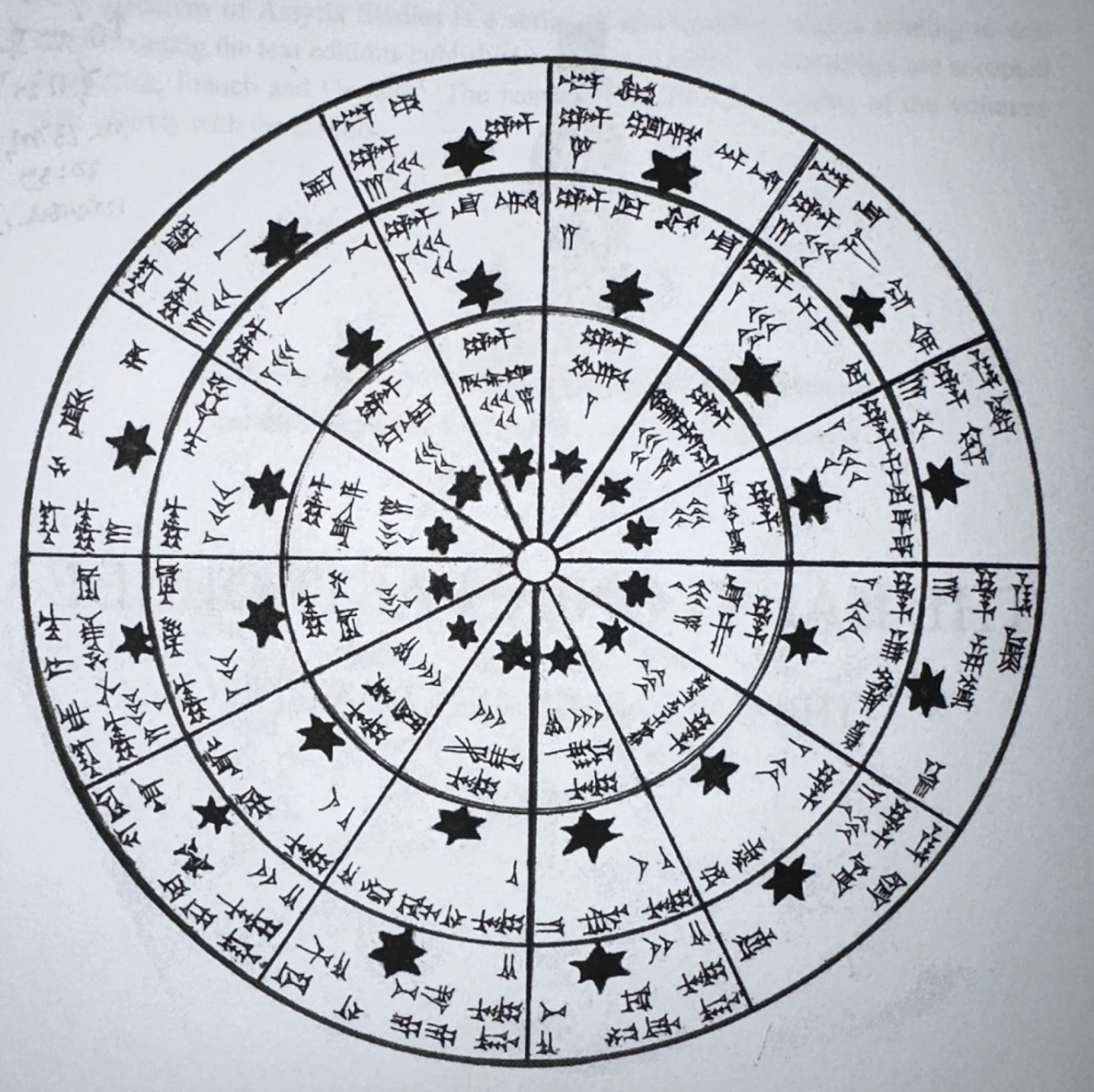
Reconstruction of the Babylonian Astrolabe by Rumen Kolev
Decanic Holograms & Stellar Sphaera: Part One of Three
By Cameron Cassidy
A hologram is a three-dimensional image replicating a view of the entire object from any perspective. Even when split in half, both copies will display the entire image; thus, every part encodes the whole. The Babylonian astrolabe is the sacred hologram of humanity's spherical image traditions, and it wove its way from the antediluvian sages to the words on these pages.
This work is, in a certain light, a vital recapitulation of scholastic knowledge attained by several German scholars from the late 19th and early 20th centuries, with many new pieces of insight from modern research on Egyptology and Assyriology. Much gratitude must be given to the shoulders on whom I stand, namely of Cumont, Boll, Gundel, and several other most illumined scholars from over a century ago.
"HE BROUGHT THE SACRED ASTROLABE": THE CREATION OF MARDUK AND THE REVELATIONS OF ENMEDURANKI
AT THE DAWN OF TIME, Marduk, the king of the celestial pantheons in Mesopotamia, was said to have ordered the cosmos, establishing Babylon as the center of the world, from where the wisdom of the starry hologram would first be founded. In a time before time, Marduk constructed the Babylonian astrolabe, establishing a new map and calendar for the universe. This sacred hologram of thirty-six stars became the archetypal map in which images and stars would assemble on the celestial spheres of all subsequent generations, civilizations, and astrological systems.
From the Enúma Elis, the tablets elucidating the creation of the cosmos according to the ancients, tablet V, 1-4:9 (Trans. Kolev, 2013: 96):
1: He [Marduk] made stations for the great Gods,
2: [he] put in place the stars symbolizing them as zodiacal signs,
3: announced the year, drew the boundaries,
4: and made three constellations to appear (heliacally rise) for each of the 12 months.
However, this sacred astrolabe was more than just a clock or a planisphere. It was a true revelation of Hermetic wisdom from before the great deluge. Its knowledge was finally brought to humanity by Lord Enmeduranki/Enmeduranna, the seventh king of antediluvian Sumer and the penultimate king to reign before the great flood (The Sumerian King List, University of Oxford). He was brought to the heavens by Shamash before the flood destroyed much of earthly civilization. He was instructed in all of the tremendous divinatory sciences (Lambert, 1967), including the wisdom of the astrolabe (Kolev, 2013: 95). Enmeduranki was the model and textual origin of the prophet Enoch, who was also instructed in divination and stellar sciences by celestial beings, and brought the wisdom back to Earth through the form of Enochian-Metatronian Merkavah mysticism (Orlov, 2006).
Kolev's reconstruction of the astrolabe reveals to us the original wisdom of the ancient Mesopotamians, showing us the first system arranged by the gods to order our time and space in the sacred segments of 36 stars. These stars were designated by Marduk to perfectly order our connection to daily, monthly, and annual time. It also is designed to properly orient oneself in the visible environment of the night sphere through the azimuthal paths of the horizon and the images rising alongside the central Eastern path.
The astrolabe shows us the ancient annual cycle of twelve months with thirty-day periods. In this time, three new images heliacally appear in the East from the beams of the Sun at sunrise, after several weeks of invisibility during the solar passage. Conversely, as the Sun approaches new images every month, three more images heliacally set or disappear in the West, barely escaping the setting Sun's crown after sunset before they disappear entirely as the Sun continues its approach.
These three images were designated to fall within the three paths of the horizon, using an azimuthal reference frame for the ascension of the images directly in the East, or leftwards towards the North-East, or to the right of the Eastern point, towards the South-East. In this sense, every month, one image or constellation will appear in the central path of Enlil, another in the Northern path of Anu, and a third in the Southern path of Ea. Likewise, three images will heliacally set in the West along the same azimuthal paths.
In this sense, 36 stars or images were tracked in their risings and settings every year, with six stars active each month, tracking 72 annual phases altogether. In Kolev's analysis of the astrolabe, his research showed that the only time in the current precessional cycle where all 36 stars rose and set in their proper paths along the horizon was during a window of a few hundred years in the 6th millennium BCE. His more precise dating takes it to around 5500 BCE (Kolev, 2013: 63). The reconstructed tablets themselves were not dated to this time but indeed show the passage of an ancient tradition that stretched deep into history. For what it's worth, the
ancients wrote the Babylonians had passed on an astrological tradition hundreds of thousands of years old, with which the Orphic astrologer Critodemus is said to have agreed (Rochberg, 2010: 4-5).
COFFIN CLOCKS FOR THE AFTERLIFE: THE RISE OF DECANS IN THE MIDDLE KINGDOM OF DYNASTIC EGYPT
Shifting our gaze to the 3rd millennium BCE in Egypt, we find the Egyptian civil calendar forming, mirroring the architecture of the Babylonian astrolabe. The discussion of Egyptian calendrical systems is a point of much discussion and debate among scholars. However, we will see that the heart of their civil calendar is a remnant of the astrolabe's wisdom. Spalinger (1995: 122) and Belmonte (2003) determined that the civil calendar was the only calendar in use during the Predynastic and Old Kingdom of Pharaonic Egypt.
In their annual calendar, they counted three seasons of four months each, with each month having thirty days, a 360-day total, finally adding five extra "epagomenal" days that sat 'outside of time.' Each month consisted of three ten-day "decades," as opposed to the later Egyptian development of four seven-day weeks. The seasons and months of the Egyptian calendar were as follows:
Akhet (Inundation): Thoth, Paophi, Athyr, Choiak
Peret (Coming Forth): Typi, Mekhir, Phamenoth, Pharmouthi
Shemu (Harvest): Pachons, Payni, Epiphi, Mesore
Besides this orderly civil calendar, there was a lunar calendar used in the temples for timing feasts, festivals, and annual religious events (Quack, 2018: 73). The dierence between the astrolabe and the Egyptian civil calendar is one of slight adjustment, where instead of seeing that after 30 days, three new images appear, the Egyptians specifically ordered the three ten-day segments of a month (one decade), in which time, one new star would heliacally appear (one Decan). Thus, three stars would appear within each civil month, one per decade. Likewise, a new star also disappears each decade, as the Fundamentals of the Courses of the Stars (or Book of Nut) tells us, "One lives and one dies every decade..." (Neugebauer & Parker, 1960, Vol. I: PL. 47; EAT I; 58).
The stars quickly assumed another crucial role alongside their counting of days and months, namely the counting of hours (Parker, 1974, 53). From the earliest cons in the Middle Kingdom, around the late third millennium BCE, where we first see the decanal star lists
appearing, we see a clock-like scheme in the tables that scholars quickly identified as using the decanal stars to mark hours throughout the night (Neugebauer & Parker, 1960).
In these decanal star clocks, we find thirty-six vertical columns running right to left, designating the time or decade of year. This is juxtaposed with twelve horizontal rows for the twelve hours of night, each row depicting one of the twelve Decanal stars, giving a sequence of rising stars for each hour of night, in that particular decade, or segment of the year. During a new decade, the rows each shift upwards one position, as after ten days, a new Decan takes the first place of the previous, which marks the first hour of night, and a new Decan comes in on the bottom row, marking the final hour of night. With each decade's ascending Decanal sequence, the table makes diagonally running lines of symbols from the bottom right to the upper left, thus coining the name 'diagonal star clocks.'
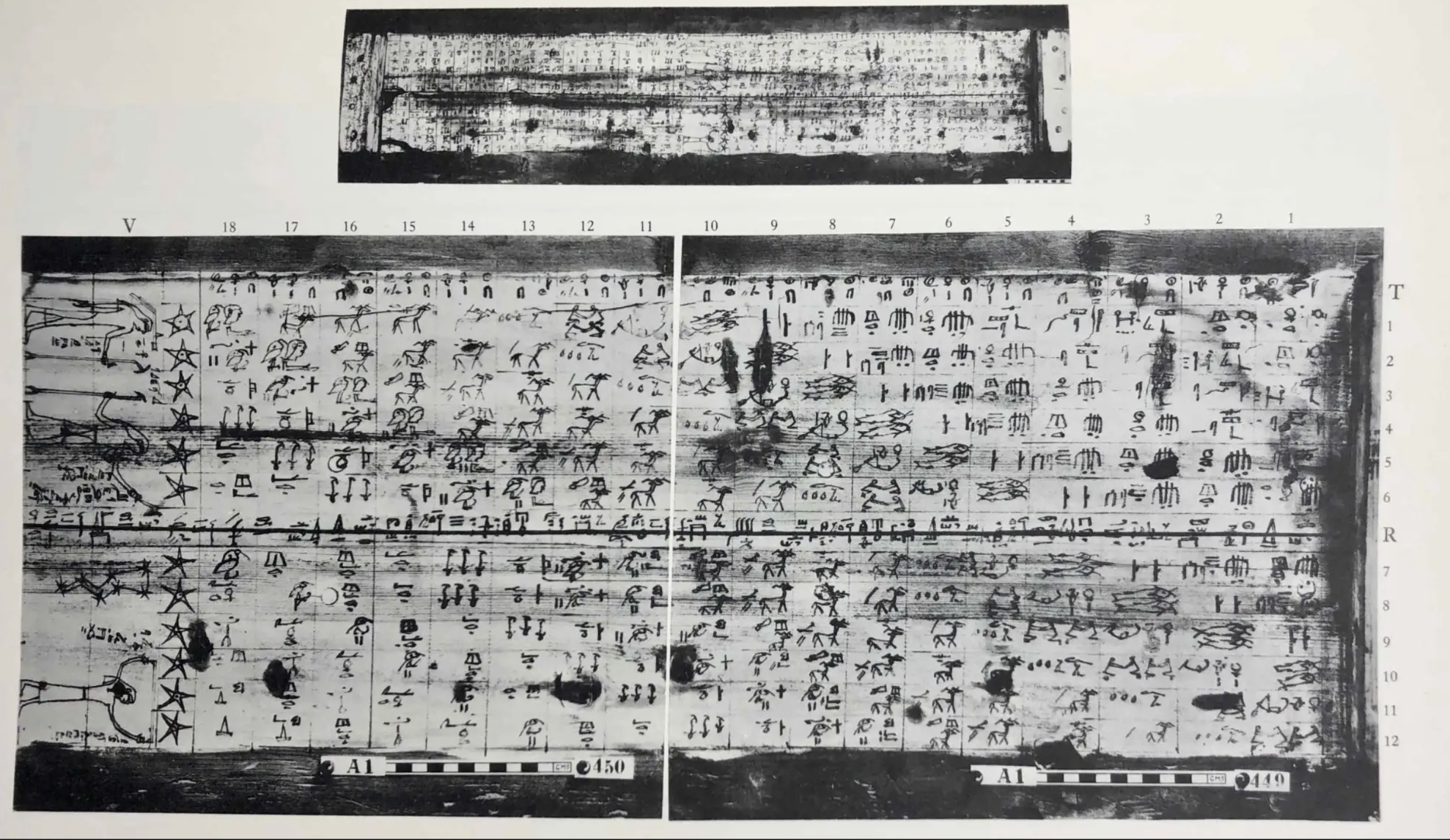
NEUGEBAUER & PARKER, EAT I: THE EARLY DECANS, COFFIN 8, PL. 14
Scholars have now identified these cons appearing from the middle kingdom to fall generally into two types: T-type cons and K-type cons (Symons, 2015a). This distinction lies primarily in the name of the Decan (beginning with a "T" sound or a "K" sound), which commences the list, as both types generally follow an identical listing of Decan stars and dier just at the starting point. Symons hypothesizes that entirely dierent ways of observing the Decans underlie this distinction (Symons, 2015b).
For the Egyptians, including these Decanal star tables and clocks on their cons was fundamental to the journey undertaken by the deceased soul in the afterlife, helping to ensure proper navigation through the realms and trials of life beyond the physical plane. We must wonder why these cons only appeared during the Middle Kingdom, with one exception being a con from the New Kingdom (Symons, 2015a), but it is most likely explained by the rise of the use of water clocks (Parker, 1974: 58).
Scholars also debate whether these con tables can genuinely be considered clocks or whether they just served symbolic, cultural, and ritual purposes upon the cons. Due to the imprecision of the schemes and the wandering of the Egyptian civil calendar from the exclusion of the remaining quarter day after the 365 days which were accounted for, the tables would need to be continually updated every forty years by one Decan, since in four years, four quarter-days shift the calendar one day from the recorded positions, and in forty years, shift things ten days o the previous scheme.
Sirius correlated to their Goddess Isis and Orion to Osiris (Belmonte & Lull, 2023: 228). The rise of Sirius's (spdt or Sothis by the Greeks) was Egypt's most important annual event. Sothis's birth from the sunbeams symbolized the restoration of the regenerative power of the cosmos. Just as her love came to humanity, so did her waters swell to nourish their lands and foster their economy and civilization.
With the calendar lacking a lunar basis or any other intercalation system, 365 days alone will not provide a faithful basis for tracking astronomical information. Due to the sidereal solar year lasting 365 and a quarter days, over four years, four quarter-days shift the diurnal turning of the Earth an extra day ahead of the calendar, which would be behind the previous year's position. Sirius would first rise in the first decade of Thoth, then the final decade of Mesore after 40 years from rising in 1 Akhet I (or 1 Thoth), and then in the middle of Mesore 40 years after that (Belmonte & Lull, 2023: 116).
Sirius or spdt, ideally in the archetypal scheme, would heliacally rise on 1 Akhet I or in the first decade of the first month of the season of inundation or flood. When Sirius rose in the first decade of the civil year, this was called the 'apokatastasis' and signaled a major celestial alignment with momentous implications (Belmonte & Lull, 2023: 138).
This happens once every 1,461 years for four years at a time, known as a tetraeteris (Fagan, 1973: 59). The complete 1,461-year cycle of the rotation of the civil calendar consists of one Sothic cycle, listed by Rhetorius as the 'complete' or 'greatest years' of the Sun (Rhetorius, 2009: 31). Essentially, it means that for Sirius to rise 1,460 times heliacally, the civil calendar will run through 1,461 times, since the solar year takes more time than the ideal calendar year which goes faster.
This monumental event happened on these notable occasions of ancient history: 4226 BCE (early settlements taking shape, entrance to Bronze Age), 2768 BCE (Old Kingdom), 1312 BCE (New Kingdom), 141 CE (Roman Period), and 1591 AD (European Renaissance).
In that sense, the diagonal Decan clocks can be of much help in dating their usage with certain calendrical adjustments recorded over time in the con clocks through the help of the motion of Sirius's rise through the civil year over periods of Egyptian history. If it says a certain Decan, which scholars have identified, rises in the middle of Mesore, then knowing where the calendar was wandering at a certain point, the con can be dated.
One source for this is Hephaistion of Thebes, writing around the early 5th century CE, who wrote in his chapter on astrological eects occurring around the rising of Sirius that "the wise Egyptians born long ago also observed the arisings of Sothis in the 25th [of the] month of Epiphi and they set out the eects of these arisings" (Hephaistion, 1994: iii-iv). Since Epiphi comes before Mesore, around 120-130 years should have passed since the previous apokatastasis in 141 CE, which dates very well with his nativity, given around 380 CE (Hephaistion, 1994: 53).
However, problems arise in that several of the cons record the star spdt or Sirius heliacally rising around the beginning of the civil year at the beginning of the first month of Thoth. Since we have from other sources this only aligned around 2768 BCE and 1312 BCE, they must either depict an ideal, older tradition (Leitz, 1995), just like the astrolabe, or modern analysis must require some major redating to centuries earlier.
The Decan star clocks are generally grouped into "Coffin Texts," or a significant category of writings about the Egyptians' afterlife beliefs written during the Middle Kingdom's acme. In the time following the Old Kingdom and the Pyramid Texts, the rituals, prayers, and spells for the deceased shifted largely to being written in the first-person voice, a considerable dierence from the prior period, where such spells were saved exclusively for the royal elite: the Pharaoh, his family, and perhaps associates. This speaks primarily to the new zeitgeist in the Middle Kingdom, opening up these sacred practices and rituals to a much more significant percentage of the Egyptian people who could afford such services.
Interested in working with the decans in your own birth chart? The 36 decans are at the heart of the Codex Mundi — a traditional astrology poster and 200+ page guidebook covering all facets of the ancient tradition. You can also book a reading to explore your own decanic story
BIBLIOGRAPHY
Adamson, G. (2013). Astrological Medicine in Gnostic Traditions. Practicing Gnosis, pp. 333–358.
Akridas, A.-G. (2021). Σαλμεσχ(ο)ινιακά: Measurement standards of astrotheology? Zeitschrift für Ägyptische Sprache und Altertumskunde 148, pp. 12–17.
Antiochus of Athens. (1993). The Thesaurus (Schmidt, R., Trans.). The Golden Hind Press. Bellizia, L. (2010). The Paranatellonta in Ancient Greek Astrological Literature.
Belmonte, J. (2003). Some open questions on the Egyptian calendar: An astronomer's view. Papers on Ancient Egypt (TdE), 2, 7-56.
Belmonte, J., & Lull, J. (2023). Astronomy of Ancient Egypt: A Cultural Perspective. Springer. Boll, F. (1903). Sphaera. Neue Griechische Texte und Untersuchungen zur Geschichte Der
Sternbilder. Von Franz Boll. B.G. Teubner, Leipzig.
Beaulieu, P.-A. (2021). Berossus and the Creation Story. Journal of Ancient Near Eastern History
2021; 8(1-2): 147-170, De Gruyter.
Bezold, C. & Boll, F. (1911). Reflexe Astrologische Keilinschriften bei Griechischen Schriftstellern. Heidelberg.
Brennan, C. (2017). Hellenistic Astrology: The Study of Fate and Fortune. Amor Fati Press.
Cumont, F. & Boll, F. & al. (1898-1936). Catalogus Codicorum Astrologorum Graecorum, Volumes I-XII.
Dalley, S. (2008). Myths from Mesopotamia: Creation, the Flood, Gilgamesh, and others. Oxford World Classics.
Deitrich, M. & Loretz, O. & Sanmartin, J. (2013). Keilalphabetische Texte aus Ugarit. The Cuneiform Alphabetic Texts from Ugarit, Ras Ibn Hani and Other Places. Münster.
Dieleman, J. (2003). Claiming the Stars: Egyptian Priests Facing the Sky. Aegyptiaca Helvetica, 17, 277-289.
Evans, J. (1998). The History and Practice of Ancient Astronomy. Oxford University Press. Fagan, C. (1973). Astrological Origins. Llewellyn.
Fagan, C. & Firebrace, B. R. C. (1971). Primer of Sidereal Astrology. American Federation of Astrologers, Inc.
Feliciano, J. P. (2015). The Sacred Book of Hermes to Asclepius. https://www.academia.edu/11429925/The_Sacred_book_of_Hermes_to_Asclepius. Accessed 21 Jan 2024.
Firmicus Maternus. (2023). Mathesis (Dykes, B., Trans.). Cazimi Press.
Gee, Emma. (2013). Aratus and the Astronomical Tradition. Oxford University Press.
George, D. (2021). Egyptian Decans: Star Gods of Time.
Gray, J. M. K. & Steele, J. M. (2007). A Study of Babylonian Observations Involving the Zodiac. Journal for the History of Astronomy, xxxviii.
Gundel, W. (1936). Dekane und Dekansternbilder: Ein Beitrag zur Geschichte der Sternbilder der Kulturvölker. Teubner, Leipzig.
Gysembergh, V. (2018). Hipparchus and the "Ancients" Nechepsos-Petosiris? JAC 33.2, pp. 165-179.
Hard, R. (2015). Eratosthenes and Hyginus: Constellation Myths, with Aratus's Phenomena. Oxford University Press.
Hephaistion of Thebes. (1994). Apotelesmatics Book I (Schmidt, R. Trans.). The Golden Hind Press.
Hephaistion of Thebes. (1998). Apotelesmatics Book II (Schmidt, R. Trans.). The Golden Hind Press.
Hollywood, L. & Steele, J. M. (2004). Acronychal Risings in Babylonian Astronomy. Centaurus 46, 145-162.
Hughes, G. R. (1951). A Demotic Astrological Text. Journal of Near Eastern Studies, Oct. 1951, Vol. 10, No. 4, pp. 256-264. University of Chicago Press.
Hunger, H. & Steele, J. (2019). The Babylonian Astronomical Compendium MUL.APIN. Routledge. In: The Sumerian King List: Translation. The Electronic Text Corpus of Sumerian Literature.
University of Oxford. https://etcsl.orinst.ox.ac.uk/section2/tr211.htm. Accessed 22 Mar 2024. James, G. J. M. (2023). Stolen Legacy: The Egyptian Origins of Western Philosophy. General Press.
Jasnow, R. & Zauzich, K.-T. (2021). Conversations in the House of Life: A New Translations of the Ancient Egyptian Book of Thoth. Harrassowitz Verlag.
Jones, A. & Steele, J. M. (2011). A New Discovery of a Component of Greek Astrology in Babylonian Tablets: The "Terms". ISAW Papers I.
Kamateros, Johannes. (1908) Eisagōgē Astronomias: ein Kompendium griechischer Astronomie und Astrologie, Meteorologie und Ethnographie in politischen Versen (Weigl, L. Trans.). Teubner, Leipzig und Berlin.
Kolev, R. (2013). The Babylonian Astrolabe: Calendar Of Creation. The Neo-Assyrian Text Corpus Project, Helsinki.
Laszlo, L. (2024). The Fragments of Nechepso and Petosiris. The HOROI Porject.
Lambert, W. G. (1967). Enmeduranki and Related Matters. Journal of Cuneiform Studies 21, 126-138. American Schools of Oriental Research, New Haven, CT.
Lehoux, D. (2007). Astronomy, Weather and Calendars in the Ancient World: Parapegmata and Related Texts in Classical and Near Eastern Societies. Cambridge University Press, Cambridge.
Leitz, C. (1995). Altägyptische Sternuhren.
Marcus Manilius. (1977). Astronomica (Goold, G.P., Trans.). Harvard University Press, Cambridge. Momigliano, A. (1975). Alien wisdom: The limits of Hellenization. Cambridge University Press.
Montelle, C. (2016), "The Anaphoricus of Hypsicles of Alexandria", in Steele, John M., The Circulation of Astronomical Knowledge in the Ancient World, Time, Astronomy, and Calendars: Texts and Studies, 6, Leiden: Brill.
Mosenkis, I. (2015a). Dodekaoros: Not Oriental but oppositional constellations and Paranatellonta. In: Academia.edu. https://www.academia.edu/11705701/Dodekaoros_not_Oriental_but_oppositional_constellatio ns_and_paranatellonta. Accessed 23 Apr 2024.
Mosenkis, I. (2015b). The sphaera barbarica: Oriental non-ptolemaic or native Greek constellations ? In: Academia.edu. https://www.academia.edu/11705682/The_Sphaera_Barbarica_Oriental_non_Ptolemaic_or_na tive_Greek_constellations_. Accessed 23 Apr 2024.
Neugebauer, O. (1943). Demotic Horoscopes. Journal of the American Oriental Society, Apr. - Jun. 1943, Vol. 63, No. 2, pp. 115-127.
Neugebauer, O. & Van Hoesen, H. B. (1959) Greek Horoscopes. American Philosophical Society, Philadelphia.
Neugebauer, O. & Parker, R.A. (1960). Egyptian Astronomical Texts. Published for Brown University Pres, by L. Humphries, Providence
Orlov, A. (2006). «the learned savant who guards the secrets of the great gods»: Evolution of the roles and titles of the Seventh antediluvian hero in Mesopotamian and Enochic traditions. Scrinium 2:165–213.
Panaino, A. (2002). "New Perspectives for an Intercultural Approach to the Sciences of Antiquity between East and West. Some Reflections on the Cultural Meaning of the MELAMMU Project." In: A. Panaino and G.
Parker, R. A. (1974). Ancient Egyptian Astronomy. Philosophical Transactions of the Royal Society of London. Series A, Mathematical and Physical Sciences, May 2, 1974, Vol. 276, No. 1257, The Place of Astronomy in the Ancient World, pp. 51-65.
Paulus of Alexandria. (2012). Introduction to Astrology (Holden, J. H., Trans.). American Federation of Astrologers.
Pettinato (eds.) Ideologies as Intercultural Phenomena. Melammu Symposia 3. Milan: Università di Bologna & IsIAO 2002, 1-12.
Plato. (1925). Plato in Twelve Volumes, Vol. 9 (Lamb, W. R. M., Trans.). Cambridge, MA, Harvard University Press; London, William Heinemann Ltd.
Porphyrios of Tyre. (2010). Introduction to the Tetrabiblos (Holden, J. H., Trans.). American Federation of Astrologers.
Ptolemy, Claudius. (1952). The Almagest (Taliaferro, R. C., Trans.). The Great Books of the Western World, The University of Chicago.
Ptolemy, Claudius. (2002). Tetrabiblos. (Ashmand, J. M. Trans.). Astrology Classics, a division of The Astrology Center of America.
Quack, J. F. (1999). Frühe Ägyptische Vorläufer der Paranatellonta? Sudhos Archiv.
Quack, J. F. (2016). On the Concomitancy of the Seemingly Incommensurable, or Why Egyptian Astral Tradition Needs to be Analyzed within Its Cultural Context. In J.M. Steele (Ed.), The Circulation of Astronomical Knowledge in the Ancient World, pp. 230-244. Brill.
Quack, J. F. (2018a). Egypt as an astronomical-astrological centre between Mesopotamia, Greece and India. In D. Brown (Ed.), The interactions of ancient Astral science (pp. 69-123). Hempen.
Quack, J. F. (2018b). Astronomy in Ancient Egypt. in P.T. Keyser & J. Scarborough (Eds.) The Oxford handbook of science and medicine in the classical world (pp. 61-70). Oxford University Press.
Quack, J. F. (2021). Priestly Scholars in Late Egypt: The Theoretical Side. Journal of Ancient Near History 2021; 8(1-2): pp. 73-90.
Rhetorius of Egypt (2009). Rhetorius the Egyptian: Astrological compendium (Holden, J. H., Trans.).Amer. Federation of Astrology, Tempe, AZ.
Rochberg, F. (1988). Elements of the Babylonian Contribution to Hellenistic Astrology. Journal of the American Oriental Society Jan. - Mar. 1988, Vol. 108, pp. 51-62.
Rochberg, F. (2010). Babylonian Astral Science in the Hellenistic World: Reception and Transmission. Center for Advanced Studies, Nummer 4 / 2010, LMU.
Ryholt, K. (2011). New Light on the Legendary King Nechepsos of Egypt. The Journal of Egyptian Archeology, vol. 97, pp. 61-72.
Schmidt, R. (2015). The Basic Course, part 2: The Eudoxus Files. Robert Schmidt Astrology: Archived Works of Robert H. Schmidt.
Spalinger, A. J. (1995). Month Representations. Chronique d'Egypte 70, 110-122.
Steele, J. M. (2017). Rising Time Schemes in Babylonian Astronomy. Springer International Publishing, Cham
Symons, S. (2015a). Contexts and elements of Decanal Star lists in Ancient Egypt. Traditions of Written Knowledge in Ancient Egypt and Mesopotamia 91–122. doi: 10.2307/j.ctv1t4m1wb.7
Symons, S. & Tasker, E. (2015b). Stars of the Dead. Scientific American 313:70–75. doi: 10.1038/scientificamerican1015-70
Thompson, G. D. Sphaera Barbarica and Sphaera Graecanica, online at: http://members.westnet.com.au/gary-david-thompson/page11-14.html
Verbrugghe, G. P. & Wickersham, J. M. (2001). Berossus and Manetho: introduced and translated, Native Traditions in Ancient Mesopotamia and Egypt. Michigan.
Vettius Valens. (2022). The Anthologies (Riley, M., Trans.). Amor Fati.
Von Bomhard, A.-S. (2008). The Naos of the Decades. From the observation of the sky to
mythology and astrology. Oxford Centre for Marine Archeology.
von Lieven, A. (2007). Grundriss Des Laufes Der Sterne. Das sogenannte Nutbuch, vol 8, The
Carlsberg Papyri. Museum Tusculanum Press, Copenhagen.
von Lieven, A. (2010). Translating the Fundamentals of the Course of the Stars. Imhausen, A. & Pommerening, T. (Eds.) Writings of Early Scholars in the Ancient Near East, Egypt, Rome, and Greece: Translating Ancient Scientific Texts (Beitrage zur Altertumskunde. Berlin 286). De Gruyter, Berlin/New York, pp. 140-150
Winkler, A. (2016). Some Astrologers and Their Handbooks in Demotic Egyptian. Steele, J. M. (Ed.) The Circulation of Astronomical Knowledge in the Ancient World, Brill.
Winkler, A. (2021). Stellar Scientists: The Egyptian Temple Astrologers. Journal of Ancient Near History 2021; 8(1-2): pp. 91-145. De Gruyter.