
The Book of Nut and the Decan Phase Cycle
Decanic Holograms & Stellar Sphaera: Part Two of Three
By Cameron Cassidy
In Part One, we traced the 36 decans from the Babylonian astrolabe through the Egyptian civil calendar and the diagonal star clocks of the Middle Kingdom. Here, we move into the New Kingdom, and into the text that gives us the most complete picture of how those 36 stars actually lived.
BRILLIANT AZURE BURNING: APOKATASTASIS & THE BOOK OF NUT IN THE NEW KINGDOM
Heading into the New Kingdom, Egypt substantially revitalized its Decanic practices through the shift from tracking rising stars on the horizon to culminating stars on the meridian (Quack, 2018b: 63-64). This shift tracks the transit of stars along the local meridian when they reach their highest altitude above the horizon before falling towards the western horizon. We can speculate several reasons this innovation arose, from the ease of sighting culminating stars to the lack of clear horizontal views due to the local environment, structures, or atmospheric conditions. To this day, astronomers still use the calculation of the culminating stars to measure sidereal time for any location on the planet, retaining a more than three-thousand-year-old time tracking method.
The primary source for analyzing the innovations of the Decanic systems at this time comes from the tomb of Seti I, who reigned around the 13th century BCE as the second Pharaoh of the 19th Dynasty. The text and his reign came during the second major apokatastasis of Egyptian history when Sirius again rose on Thoth I. The Decans listed in Sety's tomb are known as the Sety IB Decan family, whose names continued in use up to the Hellenistic astrologers (Parker, 1974: 61).
Over fifty diverse lists and names of Decans were recorded over several millennia. The most important may be the Sety IB and the Tanis family of Decans. They appear in hybrid lists in later temples, like Denderah and Esna, copied similarly by Hellenistic astrologers like Hephaistion and Maternus. The Tanis family is mysterious since it does not quite resemble the rising Decan families like the Senmut family, Seti IA, or Seti IC families, but rather something dierent
(Parker, 1973: 59). They arose around the same time as the Decanic cults and amuletic chimera began to appear on magical rings and talismans, implying an essential shift in the Decanic practice that came alongside their usage.
Sety's tomb preserves the essential text, The Fundamentals of the Courses of the Stars, and several other books like the Book of Night, the Book of Day, and even the so-called "paranatellonta texts." The latter describes the co-rising northern and southern stars along the horizon, which Quack conjectures is an early precursor to later developments of Hellenistic Astrology (Quack, 1999) or could also be a sign of long-lasting continuous interactions with Mesopotamian astrology (see Phase Shifts below).
In the Fundamentals, also called The Book of Nut, we find a grand depiction of Nut, the Goddess of the firmament, her body containing the thirty-six decanal stars, and her father Shu supporting her at her height, symbolizing the great circle of the meridian. The text describes the annual life cycle of the Decans, where the 36 Decans form new relationships with the Sun every ten days at any time of the year. It gives the ideal scheme of Sothis rising on the first of Akhet I, or the first day of the month of Thoth, and the list likely originates somewhere in the Old Kingdom, in the 3rd millennium BCE (von Lieven, 2010: 140).
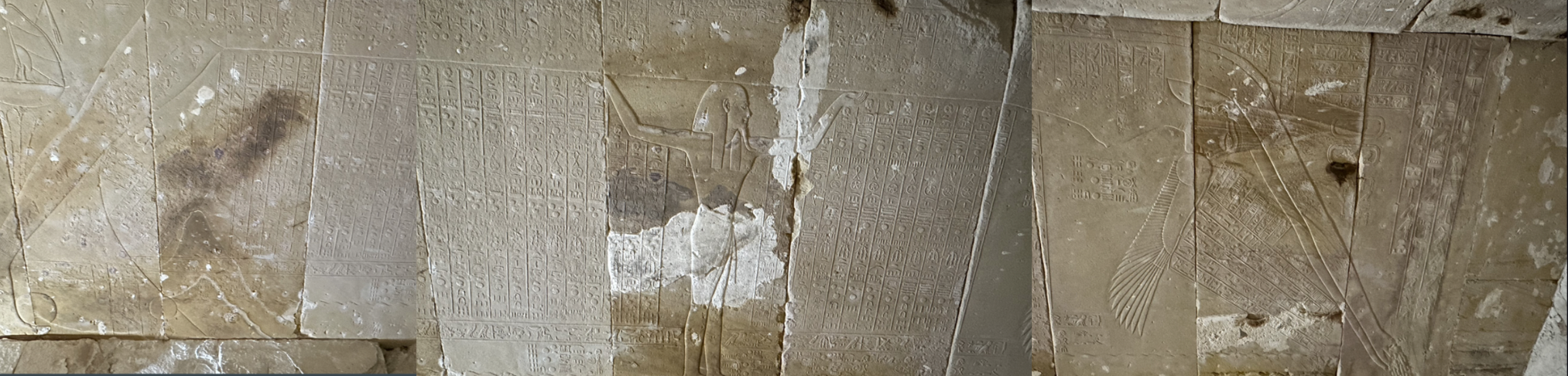
My own reconstructed image from the photos I took of the Book of Nut in the Osireion in Abydos. It’s quite large!
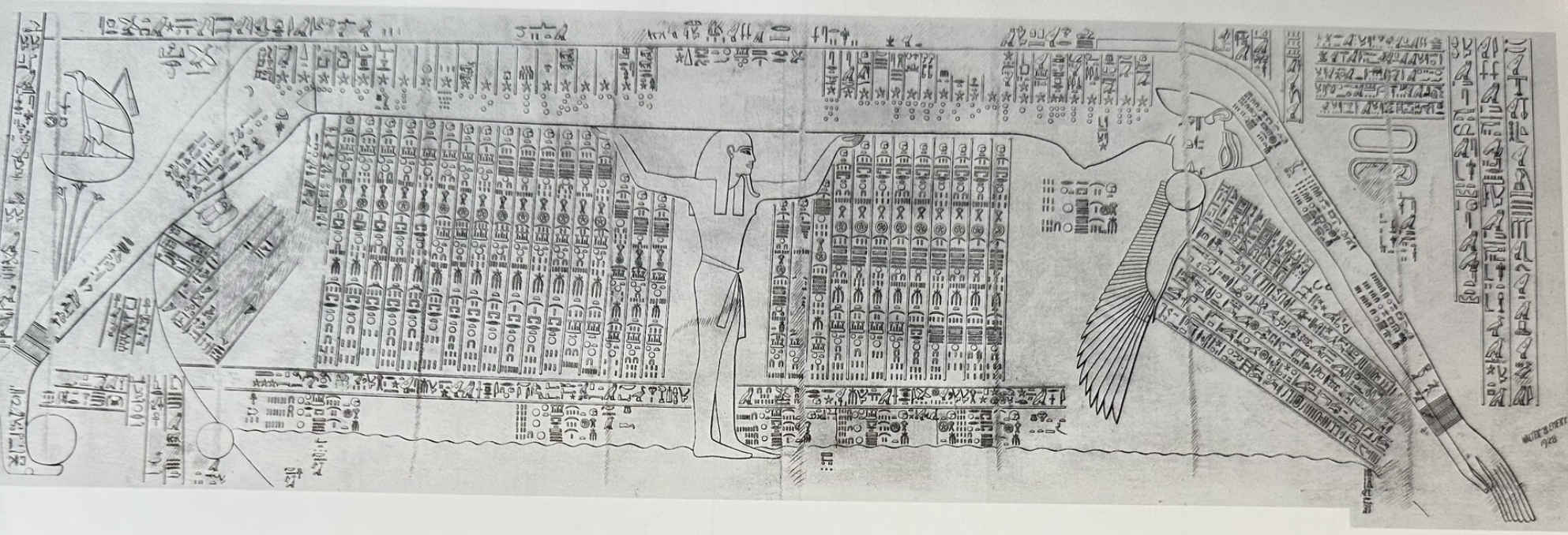
Reconstruction from Alexandra von Lieven’s publication on the Fundamentals.
The core of the scheme works as follows: In a given decade, seven stars are invisible in the heart of the Sun, eight more have recently risen from the Sun before sunrise and 'climbing' (heliacally rising), twelve will be visible crossing the meridian at night and are 'working' or counting hours, and nine Decans are 'falling' or appearing West of the meridian at night as the Sun approaches them daily (heliacally setting).
Thus, there were four original phases of the Decans:
8 were 'climbing': begins at first appearance after invisibility, as the star rises higher and higher at dawn, heliacal rising for 80 days before a visible culmination or transit of the meridian is possible since the sunlight extinguishes the star before it can 'work.'
12 were 'working': the working phase occurs while the star can visibly cross the meridian. The Book of Nut says that "the life of a star begins in the lake" (referring to the zenith of starry sky as aqueous), indicating this truly began a star's life cycle. Even though it was reborn at the rising, it is truly alive at its working. The proper phase of 'work' thus begins when it can visibly culminate for the first time, at the dawn culmination (also called the first-quarter phase or the 'extinguishing Decan' which culminates and eliminates the starlights as the Sun imminently rises)- and continues to the acronychal rising/midnight culmination/cosmic setting sequence. Finally, the acronychal culmination (last-quarter phase or 'leading Decan') happens when the star rises to the top of the decanal column, being the first to mark the hour and cross the meridian after sunset, subsequently beginning to 'fall' into the heliacal setting. These 12 Decan phases happen over the 120 days of the most critical and powerful phase of the star's annual cycle.
9 were 'falling': appearing past the meridian at sunset, no longer able to count hours for several months, moving to the heliacal setting phase for 90 days, and symbolically dying when becoming the "star at the door of the Duat," entering the underworld.
7 were in purification: invisibility, which happened for the seventy sacred days in the 'underworld,' mirroring the seventy-day embalming process of the deceased.
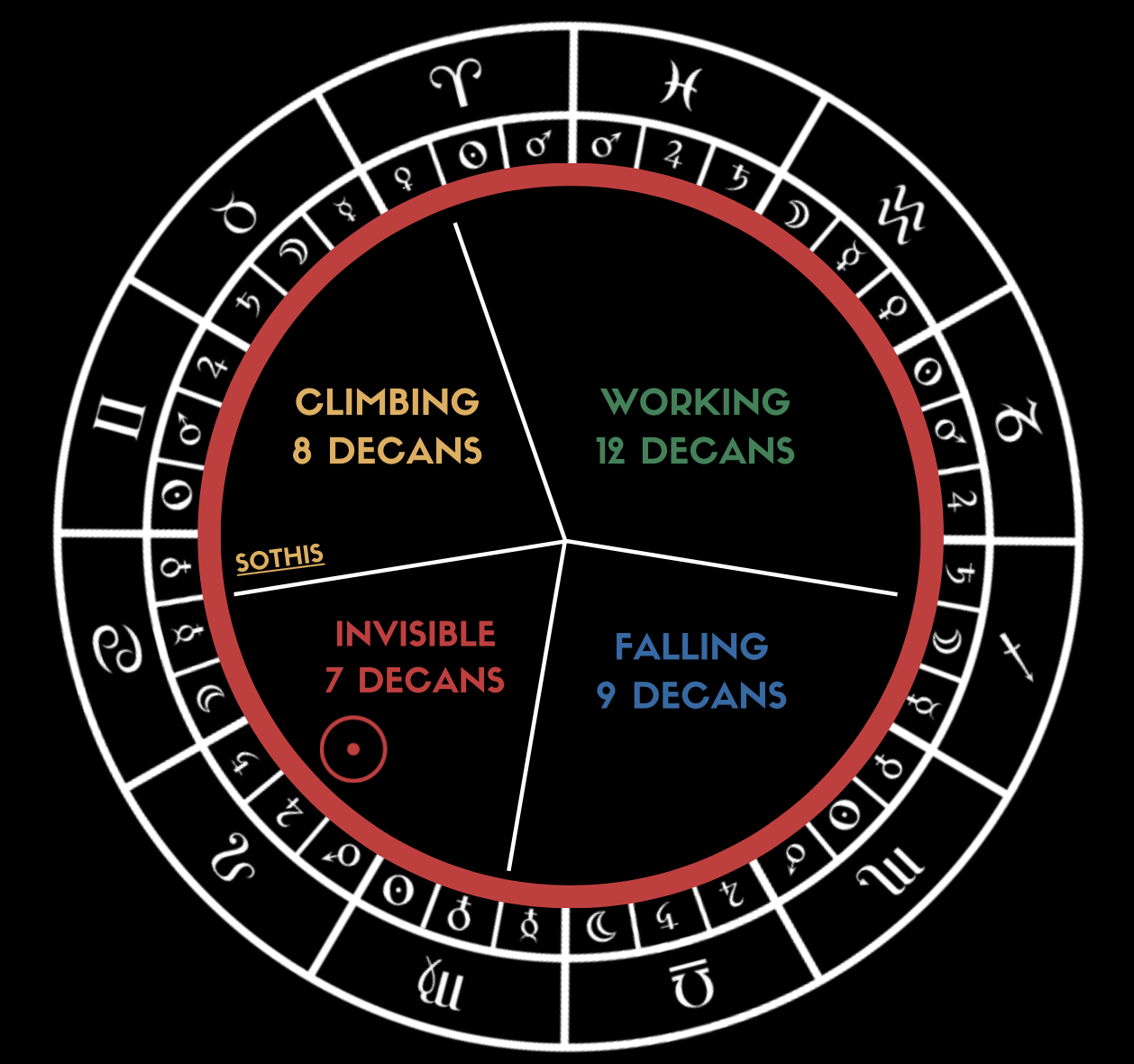
Diagram of the 4 phases, superimposed on the zodiac. Please bear in mind this does not exactly represent the conception at that time as the decans as divisions of the zodiacal signs had not fully developed after the Babylonian zodiac merged with the Decan tradition in Egypt until around the 6th century BCE.
Altogether, 8 climbing Decans, 12 working Decans, 9 falling Decans, and 7 purifying Decans give us 36 Decans, which perform the ideal cycle in 360 days. We must note that this is an idealized scheme and is challenging to reconstruct precisely on these margins, but it serves as a very close and neat representation of the Decanal phase cycle. The motions of the Decans, as described in the Book of Nut, are said to mirror Sirius (von Lieven, 2008), and even Sirius precisely followed this pattern back around the late 5th millennium BCE, perhaps harkening an echo of the ideal original Astrolabe system from that time.
The Fundamentals also gave a Decanal phase ephemeris, which mapped the unique star phases onto dates in the civil calendar (Belmonte & Lull, 2023: 129-132). Additionally, the various phases of the Decans were depicted pictorially for each Decan on the Naos from Haft el-Senna almost a millennium later (von Bomhard, 2008).
These same phases are the core pieces to understanding the cycles of stars and were recorded continuously by civilizations after this time (See Phase Shifts below). This idea of the stars rising and setting at sunrise or setting and rising at sunset encompasses the essence of ancient stellar observation. The critical element to the early astrological influences here is that the stars that rise and set together also go through these phases simultaneously and link all their astrological eects. It is as if the grand oblique circle of the horizon lassoes them all into powering the cosmos when making these phases on certain days, and both the Egyptians and Babylonians knew the divine power of these stars.
PHASE SHIFTS: THE MUL.APIN, EARLY ZODIACS & PARAPEGMA
Looking over to Babylon during the New Kingdom period in Egypt (late second millennium BCE), we find similar astronomical advancements—the MUL.APIN is the basis for all Babylonian astronomy and astrology. It includes several tablets, has been found replicated in several extant versions, and discusses a highly technical star-centric astrological system of stellar images and corresponding deities. Kolev has dated the text to fit the heliacal models of the paths in Babylon around 1200 BCE (Kolev, 2013: 104), just following the apokatastasis of Sirius and the subsequent revitalization of Decanic astrology in Egypt under Stey I through the wisdom of the Book of Nut.
The text describes the three paths of Anu, Enlil, and Ea, along with the annual heliacal rising star sequence, the intervals between the risings, which star culminates as one is heliacally rising, which stars fall in the 'path of the moon,' which stars rise as other stars set, a lunar intercalation scheme, and heliacal visibility periods of planets (Hunger & Steele, 2019: 3-4). We see a variety of star phases referenced and tracked in the Babylonian literature, especially those of the heliacal rising, acronychal rising (Hollywood & Steele, 2004), first-quarter phase (ZIQPU stars, akin to the 'extinguishing Decans'), heliacal setting, and others.
The ZIQPU stars were detailed as the stars culminating on the meridian as another heliacally rises in the East. The text uses intriguing language to describe the culminating stars as "opposite the chest" (Hunger & Steele, 2019: I iv 24): "On the 15th day of month VI, the Great Twins stand in the middle of the sky (on the meridian) opposite your chest, and Shupa and Eridu rise".
This astoundingly resembles the language in the Ramesside star clocks, another development in Egypt during the New Kingdom that describes culminating stars exclusively through the language "opposite the heart" (Belmonte & Lull, 2023: 136). The proliferation of Egyptian astrological material was simply a given, considering the expansion performed under the reign of Akhenaten in the Amarna period, going up to the Levant and Syria. This consideration can also bring light to the appearance of the 36 Decan stars in the Ugaritic texts from this region (Dietrich et al., 2013: 1.4 ("Baal and Mot"), 1.10 ("Keret: The Oering of the King"), 1.6 ("Aqhat")).
In general, with the MUL.APIN, we see the significance of the opposite stars, which rise or set simultaneously and make heliacal phases together, either as a heliacal rising/cosmic setting pair or a heliacal setting/acronychal rising pair. The linking of heliacal phases intrinsic to stars in "paranatellonta," rising (or setting) alongside one another, is a crucial component of the later Decanic texts from Teukros the Babylonian.
A few centuries after the MUL.APIN, the first evidence of the 12 sign zodiac, appears in Mesopotamia. According to Kolev and Fagan and other scholars of ancient sidereal astrology, the Babylonian Zodiac was fixed to the stars Aldebaran and Antares and formulated around the early 1st millennium BCE (Kolev, 2013: 122). It apportioned thirty degrees of the heavenly circuit to each of the 12 images in the path of the moon and the planets.
We see that these early astronomical and astrological tablets from the library of Ashurbanipal (7th century BCE) all contained a star reckoning that was not oriented to the tracking of the equinoxes (Fagan & Firebrace, 1973: 10). These first zodiacal systems led to what became the Zodiac of the Egyptians, the Demotic Stabart Tables, the Berlin Papyrus P8279- all come from the original sidereal Zodiac of the Babylonians. Additionally, at the latest, the Omen diaries and
Almanacs of the 5th century BCE show they used 12 equal segments of 30 degrees each, on a zodiac fixed sidereally by so-called 'normal stars' (Gray & Steele, 2007).
Even from the 180 horoscopes preserved from antiquity displayed in Greek Horoscopes (Neugebauer & Van Hoesen, 1960: 179-181), only seven of them contain degree listings, and none of which align the equinoctial points as the fiducial reference, meaning they were entirely sidereal (Fagan, 1973: 13). A complete discussion of the Babylonian and sidereal origins of the Zodiac are beyond this paper, but one may reference the epilogue of the Babylonian Astrolabe, "The Original System" for a complete analysis of the Babylonian design (Kolev, 2013: 133-144).
This system and its wisdom eventually came to the Greeks. It came along with all the previous knowledge from the MUL.APIN, plus the later knowledge of the exaltations, the terms/bounds (Jones & Steele, 2011), the trigons, the dodekatemories, and more (Rochberg, 1988). Pliny the Elder recounts a certain Cleostratus who supposedly brought the Zodiac from Mesopotamia to Greece around 500 BCE (Rochberg, 2010: 6-7).
In tandem with the phase ephemerides in the Book of Nut and the MUL.APIN, we also find the growing importance of the calendrical tracking of these many star phases that, over a few centuries, proliferated around the entire Mediterranean in the form of parapegma. This word has its etymology connected to the word "peg" and refers to early calendrical tracking of star phases and weather patterns on a board with a moveable peg to keep up with the changing seasons (Lehoux, 2007: 12).
Several forms of these 'parapegma' texts were purely calendrical, some astronomical, some astrological, and many meteorological, corresponding certain weather patterns to the heliacal risings or settings of stars throughout the year (Lehoux, 2007). These compositions tracked many cycles, including lunar, planetary, stellar, weather, planetary weekdays, market days, and festivals.
From the parapegma alone, we can see the MUL.APIN also played a crucial role in tandem with Egyptian star knowledge to eventually populate the further western Mediterranean region with intricate astral knowledge. This included the wisdom of the 36 stars, the monthly and annual star phases, the ascensional alignments between the stars, the calculation of the star intervals by heliacal phase and zodiacal measurements, and above all, the fruit of the iconography and symbolism behind the images themselves. This last element will come to light in Celestial Holograms further below. Many of these topics were exposed initially in the MUL.APIN, but only made it into Hipparchus and other traceable Greek astronomical texts perhaps 700 to 1000 years later.
While the growth of amuletic Decanic cults arose in Egypt, Hesiod composed his classic didactic almanac on the annual farming cycles, which were told by the heliacal phases of the fixed stars, Works and Days. It was composed around 700 BCE and is composed of all sorts of adages on the
phases of farming in rhythm with the phases of the stars. This native tradition called on several notable stars and asterisms, but the Greek Sphaera itself would not be standardized in writing until Eudoxus in the 4th century BCE (See Celestial Holograms below). Eudoxus, Euctemon, and Meton wrote the original parapegmata, which are now lost but luckily remained quoted by many later authors (Lehoux, 2007: 22).
These writings and sayings on the risings and settings of the stars were all common knowledge to the ancients, particularly the farmers and sailors (Lehoux, 2007: 138). Interestingly enough, in the Platonic dialogue called the Epinomis, the author calls out Hesiod as showcasing mere layman's knowledge of the spheres, saying only genuine astrologers have knowledge of the seven spheres beneath the eighth, not just knowing the risings and settings of the stars (Plato, 1925: Epinomis 990a). We can thank the Babylonians for first making these principles an area of layperson's knowledge.
The 36 decans and their ruling images are at the heart of the Codex Mundi — a traditional astrology wall poster and 200+ page digital guidebook. To explore your own decanic placements with me, book a reading.
BIBLIOGRAPHY
Adamson, G. (2013). Astrological Medicine in Gnostic Traditions. Practicing Gnosis, pp. 333–358.
Akridas, A.-G. (2021). Σαλμεσχ(ο)ινιακά: Measurement standards of astrotheology? Zeitschrift für Ägyptische Sprache und Altertumskunde 148, pp. 12–17.
Antiochus of Athens. (1993). The Thesaurus (Schmidt, R., Trans.). The Golden Hind Press. Bellizia, L. (2010). The Paranatellonta in Ancient Greek Astrological Literature.
Belmonte, J. (2003). Some open questions on the Egyptian calendar: An astronomer's view. Papers on Ancient Egypt (TdE), 2, 7-56.
Belmonte, J., & Lull, J. (2023). Astronomy of Ancient Egypt: A Cultural Perspective. Springer. Boll, F. (1903). Sphaera. Neue Griechische Texte und Untersuchungen zur Geschichte Der
Sternbilder. Von Franz Boll. B.G. Teubner, Leipzig.
Beaulieu, P.-A. (2021). Berossus and the Creation Story. Journal of Ancient Near Eastern History
2021; 8(1-2): 147-170, De Gruyter.
Bezold, C. & Boll, F. (1911). Reflexe Astrologische Keilinschriften bei Griechischen Schriftstellern. Heidelberg.
Brennan, C. (2017). Hellenistic Astrology: The Study of Fate and Fortune. Amor Fati Press.
Cumont, F. & Boll, F. & al. (1898-1936). Catalogus Codicorum Astrologorum Graecorum, Volumes I-XII.
Dalley, S. (2008). Myths from Mesopotamia: Creation, the Flood, Gilgamesh, and others. Oxford World Classics.
Deitrich, M. & Loretz, O. & Sanmartin, J. (2013). Keilalphabetische Texte aus Ugarit. The Cuneiform Alphabetic Texts from Ugarit, Ras Ibn Hani and Other Places. Münster.
Dieleman, J. (2003). Claiming the Stars: Egyptian Priests Facing the Sky. Aegyptiaca Helvetica, 17, 277-289.
Evans, J. (1998). The History and Practice of Ancient Astronomy. Oxford University Press. Fagan, C. (1973). Astrological Origins. Llewellyn.
Fagan, C. & Firebrace, B. R. C. (1971). Primer of Sidereal Astrology. American Federation of Astrologers, Inc.
Feliciano, J. P. (2015). The Sacred Book of Hermes to Asclepius. https://www.academia.edu/11429925/The_Sacred_book_of_Hermes_to_Asclepius. Accessed 21 Jan 2024.
Firmicus Maternus. (2023). Mathesis (Dykes, B., Trans.). Cazimi Press.
Gee, Emma. (2013). Aratus and the Astronomical Tradition. Oxford University Press.
George, D. (2021). Egyptian Decans: Star Gods of Time.
Gray, J. M. K. & Steele, J. M. (2007). A Study of Babylonian Observations Involving the Zodiac. Journal for the History of Astronomy, xxxviii.
Gundel, W. (1936). Dekane und Dekansternbilder: Ein Beitrag zur Geschichte der Sternbilder der Kulturvölker. Teubner, Leipzig.
Gysembergh, V. (2018). Hipparchus and the "Ancients" Nechepsos-Petosiris? JAC 33.2, pp. 165-179.
Hard, R. (2015). Eratosthenes and Hyginus: Constellation Myths, with Aratus's Phenomena. Oxford University Press.
Hephaistion of Thebes. (1994). Apotelesmatics Book I (Schmidt, R. Trans.). The Golden Hind Press.
Hephaistion of Thebes. (1998). Apotelesmatics Book II (Schmidt, R. Trans.). The Golden Hind Press.
Hollywood, L. & Steele, J. M. (2004). Acronychal Risings in Babylonian Astronomy. Centaurus 46, 145-162.
Hughes, G. R. (1951). A Demotic Astrological Text. Journal of Near Eastern Studies, Oct. 1951, Vol. 10, No. 4, pp. 256-264. University of Chicago Press.
Hunger, H. & Steele, J. (2019). The Babylonian Astronomical Compendium MUL.APIN. Routledge. In: The Sumerian King List: Translation. The Electronic Text Corpus of Sumerian Literature.
University of Oxford. https://etcsl.orinst.ox.ac.uk/section2/tr211.htm. Accessed 22 Mar 2024. James, G. J. M. (2023). Stolen Legacy: The Egyptian Origins of Western Philosophy. General Press.
Jasnow, R. & Zauzich, K.-T. (2021). Conversations in the House of Life: A New Translations of the Ancient Egyptian Book of Thoth. Harrassowitz Verlag.
Jones, A. & Steele, J. M. (2011). A New Discovery of a Component of Greek Astrology in Babylonian Tablets: The "Terms". ISAW Papers I.
Kamateros, Johannes. (1908) Eisagōgē Astronomias: ein Kompendium griechischer Astronomie und Astrologie, Meteorologie und Ethnographie in politischen Versen (Weigl, L. Trans.). Teubner, Leipzig und Berlin.
Kolev, R. (2013). The Babylonian Astrolabe: Calendar Of Creation. The Neo-Assyrian Text Corpus Project, Helsinki.
Laszlo, L. (2024). The Fragments of Nechepso and Petosiris. The HOROI Porject.
Lambert, W. G. (1967). Enmeduranki and Related Matters. Journal of Cuneiform Studies 21, 126-138. American Schools of Oriental Research, New Haven, CT.
Lehoux, D. (2007). Astronomy, Weather and Calendars in the Ancient World: Parapegmata and Related Texts in Classical and Near Eastern Societies. Cambridge University Press, Cambridge.
Leitz, C. (1995). Altägyptische Sternuhren.
Marcus Manilius. (1977). Astronomica (Goold, G.P., Trans.). Harvard University Press, Cambridge. Momigliano, A. (1975). Alien wisdom: The limits of Hellenization. Cambridge University Press.
Montelle, C. (2016), "The Anaphoricus of Hypsicles of Alexandria", in Steele, John M., The Circulation of Astronomical Knowledge in the Ancient World, Time, Astronomy, and Calendars: Texts and Studies, 6, Leiden: Brill.
Mosenkis, I. (2015a). Dodekaoros: Not Oriental but oppositional constellations and Paranatellonta. In: Academia.edu. https://www.academia.edu/11705701/Dodekaoros_not_Oriental_but_oppositional_constellatio ns_and_paranatellonta. Accessed 23 Apr 2024.
Mosenkis, I. (2015b). The sphaera barbarica: Oriental non-ptolemaic or native Greek constellations ? In: Academia.edu. https://www.academia.edu/11705682/The_Sphaera_Barbarica_Oriental_non_Ptolemaic_or_na tive_Greek_constellations_. Accessed 23 Apr 2024.
Neugebauer, O. (1943). Demotic Horoscopes. Journal of the American Oriental Society, Apr. - Jun. 1943, Vol. 63, No. 2, pp. 115-127.
Neugebauer, O. & Van Hoesen, H. B. (1959) Greek Horoscopes. American Philosophical Society, Philadelphia.
Neugebauer, O. & Parker, R.A. (1960). Egyptian Astronomical Texts. Published for Brown University Pres, by L. Humphries, Providence
Orlov, A. (2006). «the learned savant who guards the secrets of the great gods»: Evolution of the roles and titles of the Seventh antediluvian hero in Mesopotamian and Enochic traditions. Scrinium 2:165–213.
Panaino, A. (2002). "New Perspectives for an Intercultural Approach to the Sciences of Antiquity between East and West. Some Reflections on the Cultural Meaning of the MELAMMU Project." In: A. Panaino and G.
Parker, R. A. (1974). Ancient Egyptian Astronomy. Philosophical Transactions of the Royal Society of London. Series A, Mathematical and Physical Sciences, May 2, 1974, Vol. 276, No. 1257, The Place of Astronomy in the Ancient World, pp. 51-65.
Paulus of Alexandria. (2012). Introduction to Astrology (Holden, J. H., Trans.). American Federation of Astrologers.
Pettinato (eds.) Ideologies as Intercultural Phenomena. Melammu Symposia 3. Milan: Università di Bologna & IsIAO 2002, 1-12.
Plato. (1925). Plato in Twelve Volumes, Vol. 9 (Lamb, W. R. M., Trans.). Cambridge, MA, Harvard University Press; London, William Heinemann Ltd.
Porphyrios of Tyre. (2010). Introduction to the Tetrabiblos (Holden, J. H., Trans.). American Federation of Astrologers.
Ptolemy, Claudius. (1952). The Almagest (Taliaferro, R. C., Trans.). The Great Books of the Western World, The University of Chicago.
Ptolemy, Claudius. (2002). Tetrabiblos. (Ashmand, J. M. Trans.). Astrology Classics, a division of The Astrology Center of America.
Quack, J. F. (1999). Frühe Ägyptische Vorläufer der Paranatellonta? Sudhos Archiv.
Quack, J. F. (2016). On the Concomitancy of the Seemingly Incommensurable, or Why Egyptian Astral Tradition Needs to be Analyzed within Its Cultural Context. In J.M. Steele (Ed.), The Circulation of Astronomical Knowledge in the Ancient World, pp. 230-244. Brill.
Quack, J. F. (2018a). Egypt as an astronomical-astrological centre between Mesopotamia, Greece and India. In D. Brown (Ed.), The interactions of ancient Astral science (pp. 69-123). Hempen.
Quack, J. F. (2018b). Astronomy in Ancient Egypt. in P.T. Keyser & J. Scarborough (Eds.) The Oxford handbook of science and medicine in the classical world (pp. 61-70). Oxford University Press.
Quack, J. F. (2021). Priestly Scholars in Late Egypt: The Theoretical Side. Journal of Ancient Near History 2021; 8(1-2): pp. 73-90.
Rhetorius of Egypt (2009). Rhetorius the Egyptian: Astrological compendium (Holden, J. H., Trans.).Amer. Federation of Astrology, Tempe, AZ.
Rochberg, F. (1988). Elements of the Babylonian Contribution to Hellenistic Astrology. Journal of the American Oriental Society Jan. - Mar. 1988, Vol. 108, pp. 51-62.
Rochberg, F. (2010). Babylonian Astral Science in the Hellenistic World: Reception and Transmission. Center for Advanced Studies, Nummer 4 / 2010, LMU.
Ryholt, K. (2011). New Light on the Legendary King Nechepsos of Egypt. The Journal of Egyptian Archeology, vol. 97, pp. 61-72.
Schmidt, R. (2015). The Basic Course, part 2: The Eudoxus Files. Robert Schmidt Astrology: Archived Works of Robert H. Schmidt.
Spalinger, A. J. (1995). Month Representations. Chronique d'Egypte 70, 110-122.
Steele, J. M. (2017). Rising Time Schemes in Babylonian Astronomy. Springer International Publishing, Cham
Symons, S. (2015a). Contexts and elements of Decanal Star lists in Ancient Egypt. Traditions of Written Knowledge in Ancient Egypt and Mesopotamia 91–122. doi: 10.2307/j.ctv1t4m1wb.7
Symons, S. & Tasker, E. (2015b). Stars of the Dead. Scientific American 313:70–75. doi: 10.1038/scientificamerican1015-70
Thompson, G. D. Sphaera Barbarica and Sphaera Graecanica, online at: http://members.westnet.com.au/gary-david-thompson/page11-14.html
Verbrugghe, G. P. & Wickersham, J. M. (2001). Berossus and Manetho: introduced and translated, Native Traditions in Ancient Mesopotamia and Egypt. Michigan.
Vettius Valens. (2022). The Anthologies (Riley, M., Trans.). Amor Fati.
Von Bomhard, A.-S. (2008). The Naos of the Decades. From the observation of the sky to
mythology and astrology. Oxford Centre for Marine Archeology.
von Lieven, A. (2007). Grundriss Des Laufes Der Sterne. Das sogenannte Nutbuch, vol 8, The
Carlsberg Papyri. Museum Tusculanum Press, Copenhagen.
von Lieven, A. (2010). Translating the Fundamentals of the Course of the Stars. Imhausen, A. & Pommerening, T. (Eds.) Writings of Early Scholars in the Ancient Near East, Egypt, Rome, and Greece: Translating Ancient Scientific Texts (Beitrage zur Altertumskunde. Berlin 286). De Gruyter, Berlin/New York, pp. 140-150
Winkler, A. (2016). Some Astrologers and Their Handbooks in Demotic Egyptian. Steele, J. M. (Ed.) The Circulation of Astronomical Knowledge in the Ancient World, Brill.
Winkler, A. (2021). Stellar Scientists: The Egyptian Temple Astrologers. Journal of Ancient Near History 2021; 8(1-2): pp. 91-145. De Gruyter.